
Leccinellum crocipodium
Taxonomy
Main synonym
Common names
Boleto cuarteado, onddo beltzkor.
Geographic references:
Interactive map with data from GBIF.



Morphological Features:
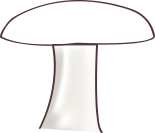
Pileus of medium size; the diameter of fully developed specimens typically ranges from 10 to 15 cm. Initially hemispherical, it becomes convex and finally plano-convex, without becoming completely flattened. It exhibits a yellowish or olivaceous suffused coloration and a dry, glabrous cuticle, often rugulose, which tends to crack over time or during periods of low rainfall; under these conditions, it acquires brownish tints. It does not bruise blue upon handling but tends to become soiled.
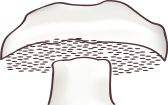
Tubes bright yellow in young specimens, later becoming dull olivaceous; adnate, with a tendency to become slightly free in older specimens. They exhibit a marked tendency to blacken both upon cutting and handling.
Pores concolorous with the tubes and small in size; like the tubes, they blacken upon handling.
Stipe generally longer than the pileus diameter, cylindrical and solid, typically thicker in the central region and narrower at both the apex and base. It is whitish or pale yellowish in color and entirely covered with granulations that are concolorous in young individuals but become dark brownish-black later.
Flesh thick in both the pileus and stipe; firm in young specimens but tending to become spongy with age. It is pale yellowish in color. Upon cutting, it sometimes blackens directly, but more commonly turns pinkish, then violet, and finally black.
Habitat:
A thermophilic species that fruits primarily during summer and the warmer part of autumn. It is quite abundant in certain areas, fruiting preferentially in oak forests, though it may occasionally appear under other broadleaf trees.
Observations:
It is characterized by its marked tendency to blacken upon cutting and its occurrence under oaks. This is a non-toxic species that can be classified as edible, yet it is culinarily mediocre, of significantly lower quality than Leccinellum lepidum, a species with which it may be easily confused; the latter is typical of holm oak woodlands and exhibits less pronounced color changes upon cutting. A closely related species associated with Cistus shrubs is Lecinellum corsicum, with which it shares many similarities. It is highly unlikely to be mistaken for toxic species.