
Laetiporus sulphureus
Taxonomy
Main synonym
Common names
Poliporo azufrado, bolo de garrofera, ardagai-hori, girgola groga, chicken mushroom.
Geographic references:
Interactive map with data from GBIF.

Morphological Features:
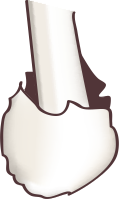
Basidiocarp appearing annually, of considerable size; specimens approaching 50 cm in width have been recorded, though typically they are about half that size, projecting up to 20 cm with a thickness of merely 1 or 2 cm. The species is particularly notable for its intense, striking orange coloration, although it can sometimes appear somewhat more yellowish. It typically occurs as imbricate or overlapping basidiocarps, projecting perpendicularly from the substrate, shelf-like or tongue-shaped, sometimes taking more irregular forms, although when young they are quite homogeneous and rounded. The margin or growth zone is rounded and much paler in color, almost whitish.
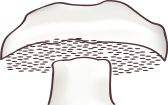
Hymenium porous, composed of very short tubes terminating in intensely sulfur-yellow pores. The pore density is 2 to 3 per mm, and they are quite rounded.
Stipe absent; this is a species that attaches directly to the substrate.
Flesh not overly thick, whitish in color contrasting with the external coloration of the fungus; relatively soft when young, later becoming hard and coriaceous. It possesses a fairly noticeable acidic odor, though not unpleasant, and its flavor is said by some to resemble chicken, although it is also somewhat sour.
Habitat:
This is a common species that fruits on living and wounded trees, occasionally and exceptionally on dead wood. It generally occurs on broadleaf trees, typically oak and chestnut. It is a parasitic fungus that may appear at any time of year except during winter.
Observations:
Although considered edible in many mycological treatises, we have chosen to classify it as without culinary value, because only undeveloped specimens are suitable for consumption, which we do not consider advisable. Furthermore, the consumption of mature specimens in conjunction with alcohol is highly dangerous. We consider that, due to its striking coloration and distinctive features, it is an almost unmistakable species.
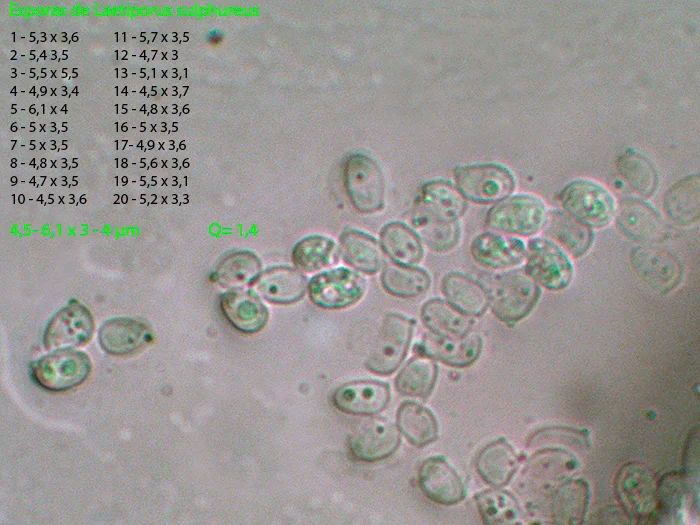
Microscopy of Laetiporus sulphureus