Lactarius pubescens
Taxonomy
Main synonym
Common names
Lactario peludo.
Geographic references:
Interactive map with data from GBIF.




Morphological Features:
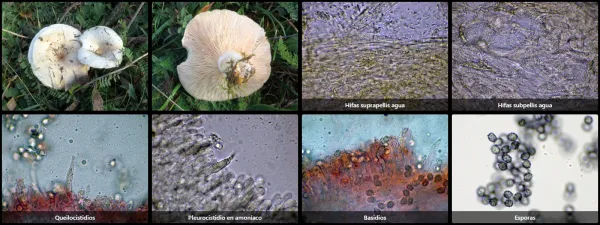
Pileus with a diameter that in adult specimens can reach 10 cm, commonly between 4 and 8 cm. Initially convex with the margin strongly incurved, later flattening out while maintaining an involute margin for some time, finally depressed or infundibuliform with a straight margin. Surface covered with dense hairs in its early stages; later these hairs persist only at the margin. At maturity, it is smooth or simply tomentose overall. Color is variable; in most collected specimens, a whitish or creamy hue predominates, with faint pinkish or flesh-toned tinges in many individuals, while in a few, the pinkish-flesh color dominates over white. Completely lacks concentric zonations.
Lamellae adnate to subdecurrent, dense and crowded, similar in color to the pileus, staining ochraceous upon handling.
Stipe generally short, solid when young becoming hollow at maturity, similar in color to the rest of the fruitbody and staining dirty ochraceous upon handling. Smooth, lacking the hairs present on the pileus.
Flesh firm and thick, white in color; exudes latex of the same color, which remains unchanged in air but yellows weakly on a white cloth. Odor is not unpleasant, somewhat fruity with floral notes, but the taste is notably acrid and disagreeable.
Habitat:
This is a species we locate every year under birches; curiously, all plantings of these trees in public gardens are mycorrhizal with these fungi, which in some cases fruit profusely. Grows in groups during autumn; we have not observed it outside this exclusive habitat.
Observations:
The color variability of this species, sometimes white and at other times pinkish-flesh or reddish, has led to the belief that Lactarius blumii or cilicioides were distinct species, but it has been demonstrated that they are the same species. It was also considered for a time as a variety of Lactarius torminosus, which also fruits under birches but in more mountainous areas, and from which it is distinguished by its paler whitish tone and the absence of concentric zonations. Lactarius mairei, with a more Mediterranean distribution under broadleaf trees, closely resembles it, as does Lactarius citriolens, which has an odor reminiscent of lemon peel.