Lactifluus piperatus
Taxonomy
Main synonym
Common names
Lactario pimentero, pebraza, pebrás illeter, esne-min, esneki zuri-orribildu, pementeiro.
Geographic references:
Interactive map with data from GBIF.




Morphological Features:
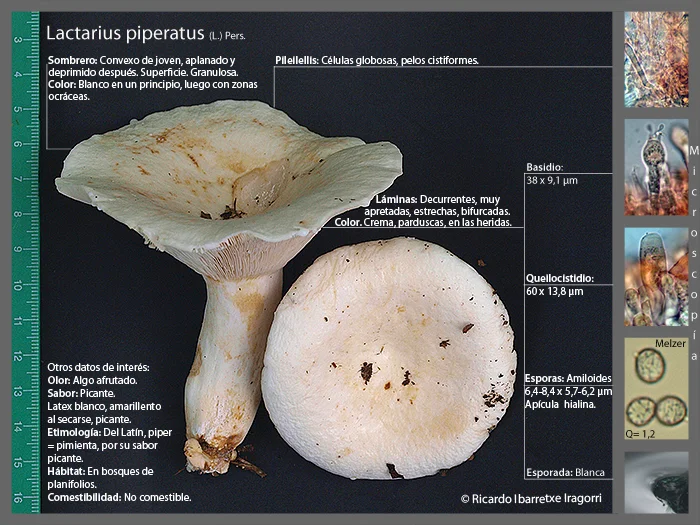
Pileus often exceeding 10 cm in diameter, convex with a well-defined central depression, later becoming infundibuliform and thus forming a depressed center. Pure white, especially when young, acquiring some ochre blotches with age; the surface is glabrous and smooth. The margin is incurved in young specimens, later becoming thin and slightly undulate.
Lamellae decurrent and extremely crowded, to the point that in the early stages of development they are barely visible to the naked eye. Thin and narrow, white in color except when old, when they become stained with creamy tones.
Stipe generally short, although specimens with a longer stipe are found under certain substrate conditions; solid and firm, usually tapering towards the base. Smooth or slightly pruinose, similar in color to the pileus, but sometimes blotched with ochraceous tones at the base.
Flesh thick and firm, hard, white in color. Upon cutting, it turns slightly yellowish, and exudes a scant latex, also white in color. Its odor is between fungoid and fruity, not unpleasant, and its taste is extremely pungent.
Habitat:
A relatively frequent species that begins to appear during spring, with its fruiting period extending into early autumn. It can therefore be considered a thermophilous species that fruits under broadleaf trees.
Observations:
Not edible due to its extremely pungent taste when raw; after cooking, despite losing most of its pungency, it still tastes unpleasant. The species Lactarius pergamenus=Lactarius glaucescens is very similar, almost identical, and begins to fruit slightly later; its latex turns olive-green upon drying on the lamellae, and furthermore reacts vigorously with potassium hydroxide (KOH), which is not the case for the species described here. Other white Lactarius species, such as Lactarius vellereus or Lactarius controversus, have much more widely spaced lamellae.
Microscopy of Lactifluus piperatus