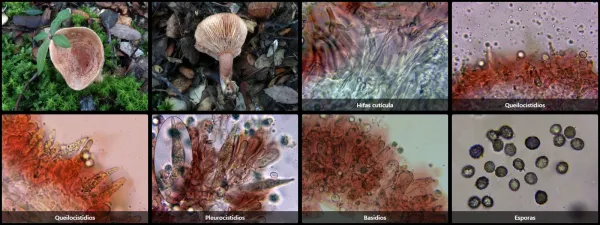
Lactarius chrysorrheus
Taxonomy
Main synonym
Common names
Lactario de leche dorada, falso níscalo, esnehorikor arrunt, pinetell bord.
Geographic references:
Interactive map with data from GBIF.




Morphological Features:
Pileus up to 10 cm in diameter at maturity, though specimens typically range between 3 and 7 cm. Initially convex, it flattens with age and eventually becomes slightly depressed in the center. The color is ocher with orange tints, commonly displaying concentric zones of darker tones. The cuticle is somewhat glossy when wet but generally appears dry, smooth, and glabrous. The margin is involute in young specimens, becoming smooth and barely undulate in mature ones.
Lamellae subdecurrent, pale cream in color, developing pinkish tones with age. Due to the latex, they yellow at points of injury. They are relatively crowded and feature numerous intercalated lamellulae.
Stipe proportional to the pileus size or short, solid when young, becoming hollow with age. It is light-colored, pale cream, but also develops flesh-toned or pinkish hues like the lamellae over time. It is never scrobiculate; moreover, it is smooth, only weakly pruinose in its early stages.
Flesh firm and brittle, white in color. It exudes an abundant latex that, despite being initially white, turns yellow instantaneously upon exposure to air. The latex is sweet at first but becomes very pungent; the taste is similarly very pungent, and the odor is mild and fungal.
Habitat:
This is a species characteristic of broadleaf forests; we have never observed it in any other habitat. It fruits during the autumn months, either solitary or in small groups. It is a fairly common mushroom that we encounter without difficulty each year.
Observations:
Somewhat inexplicably, it is frequently confused with chanterelles, which have orange latex and do not share this habitat. Lactarius zonarius, which also features a zoned pileal surface, is readily distinguished because its white latex remains unchanging upon contact with air. Other Lactarius species with yellowing latex are Lactarius decipiens and Lactarius theiogalus, but they lack a zoned cap; thus, we consider that the species presented here is clearly differentiated from others.