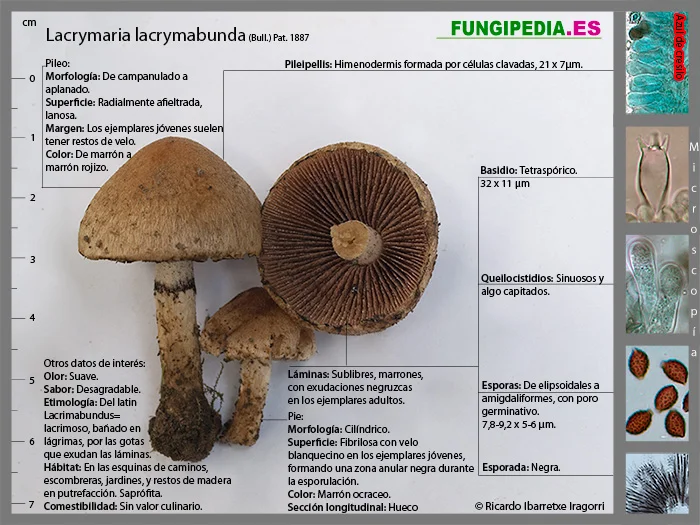

Lacrymaria lacrymabunda
Taxonomy
Main synonym
Common names
Lacrimaria aterciopelada, drosofila malkodun.
Geographic references:
Interactive map with data from GBIF.



Morphological Features:
Pileus initially attached to the stipe in a spherical shape, gradually expanding to become convex and finally flattening out, though sometimes retaining a slightly pronounced umbo. Adult specimens range from 5 to 8 cm in diameter, but when closed do not exceed 3 cm. Typically ochraceous, darker at the center and fading toward the margin, though it may exhibit brownish or more typically reddish or tawny hues. The surface is covered with highly visible, woolly fibers giving it a velvety appearance. Margin regular, incurved in young specimens.
Lamellae adnate, brownish when young, turning blackish with maturity. They exude tear-like droplets that turn black upon sporulation. Rather widely spaced.
Stipe elongated and cylindrical, similar in color to the pileus, paler when young. Cross-section reveals it to be hollow. Its surface is highly fibrillose, as with the pileus, and bears a ring formed by remnants of the partial veil deposited on the stipe, some of which also remain on the pileal margin. This fibrillose ring tends to darken as spores from the hymenium deposit upon it.
Flesh not very thick and fragile, ochre or brown in color, fibrous in the stipe. Odor faintly fungoid; taste sweet.
Habitat:
A highly prolific mushroom that fruits in almost any location; we have observed it in oak woods, pine forests, along road edges, on lawns, in public gardens, etc. It typically appears in summer and more prominently during early autumn. Found in large groups, being both frequent and abundant.
Observations:
Despite its unappealing appearance leading one to doubt its edibility, this mushroom does not have a bad taste; however, it is rather thin-fleshed, which significantly detracts from its culinary value. Its woolly pileus and stipe are identifying features, as are the tear-like droplets that give it its name. A similar species exists whose separation from the present one is, at best, doubtful: Lacrymaria pyrotricha. While some authors consider them synonymous, others distinguish them based on subtle spore morphology, noting that in the species presented here the spores are amygdaliform, whereas in pyrotricha they are ellipsoid.
Microscopy of Lacrymaria lacrymabunda