Lachnum virgineum
Taxonomy
Main synonym
Common names
Not available
Geographic references:
Interactive map with data from GBIF.




Morphological Features:
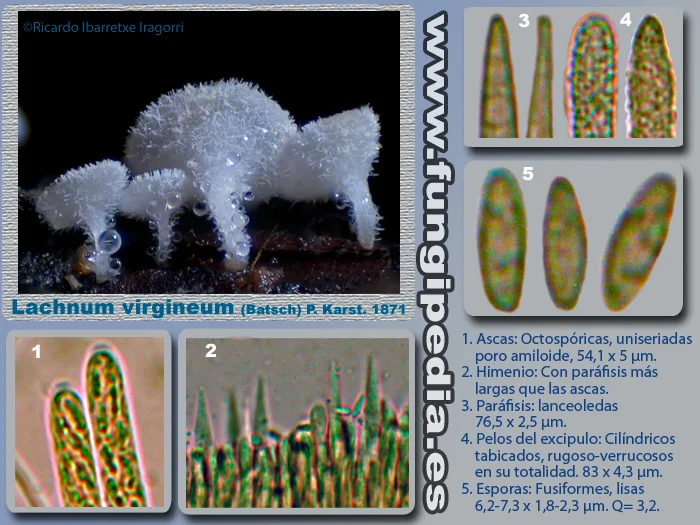
Carpophore of minute size, its diameter at best barely reaches a few millimeters. In its initial stage it is cup-shaped, but quickly becomes inflated; flattened specimens are very rare. The margin of this cup clearly tends to become involute, and here the hairs covering the entire external surface or exciple are more prominent. Both the exciple itself and the hairs covering it are pure white, virginal as indicated by the species name, but older specimens may acquire creamy or yellowish tones.
Hymenium smooth, lacking hairs, located on the internal surface of the ascocarp, also white in color like the rest. At the attachment to the stipe, an umbilicate zone is apparent.
Stipe very short, sometimes sunken into the substrate but distinct, appearing as a continuation of the excipular zone; like it, it is covered in hairs and is white.
Flesh entirely insignificant, white in color, with nothing noteworthy regarding odor or taste.
Habitat:
This Ascomycete species has a fairly broad ecology and distribution; due to its size it may go unnoticed, but we consider it a frequent species. It fruits practically year-round on woody debris in general. Our collection was made in March on buried or half-buried cones of Pinus sylvestris, which were found colonized by numerous individuals.
Observations:
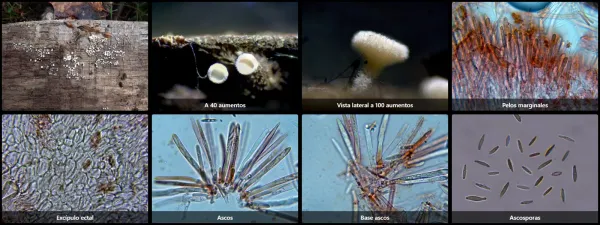
Differentiating these minute species requires the aid of a microscope (see microscopic data). Dasyscyphella nivea is very similar, but its marginal hairs are not granulose along their entire length; they are septate and slightly granulose except at the apex, which is inflated, nor does it possess lanceolate paraphyses. Hymenoscyphus fructigenus may resemble the described species, but lacks hairs and fruits on fruits or samaras of various trees, being commonly found on beech nuts.
Microscopy of Lachnum virgineum