
Lachnum pygmaeum
Taxonomy
Main synonym
Common names
Lachnum pigmeo
Geographic references:
Interactive map with data from GBIF.



Morphological Features:
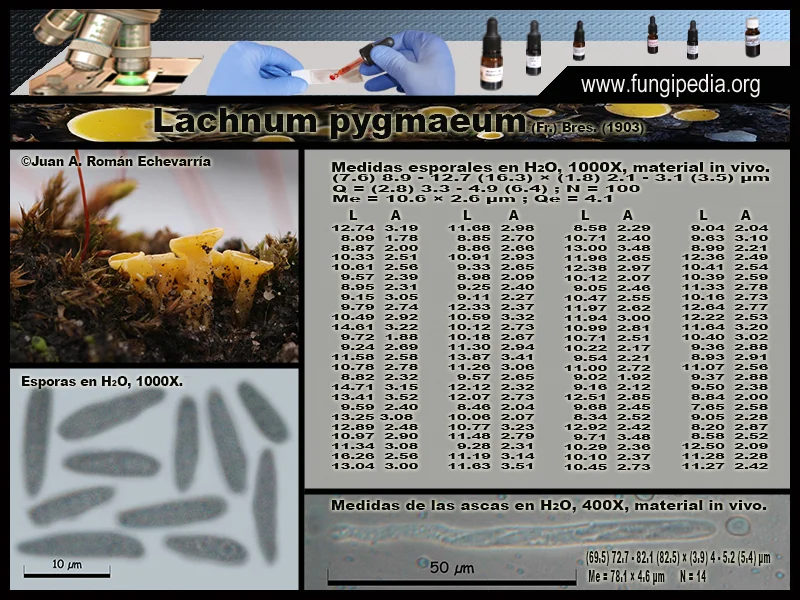
Carpophore consisting of a stipitate apothecium in which all parts form an inseparable whole, as its name implies. It is certainly small in size; a specimen of this species barely reaches, at best, 6 to 7 mm in height by 3 to 5 mm in width across its upper region. Despite their diminutive stature, they were relatively easy to locate due to the abundance of specimens and the striking contrast of their colors: yellow above and white below. The upper region is initially cupulate and later becomes flattened, featuring a yellow internal surface and a white external surface, supported by the stipe.
Hymenium or fertile part of the apothecium, completely smooth and situated on the upper surface, displaying a beautiful egg-yellow color that strongly contrasts with the whitish hue of the remainder. Spores are elongated and fusiform; asci are 8-spored and biseriate. It also features the typical lanceolate paraphyses characteristic of *Lachnum*, which exsert beyond the asci, all of which can be observed in our microscopy section.
Stipe elongated relative to the upper region, though variable in length, ranging from barely 3 mm in some specimens to up to 7 mm in others. It is white in color and covered with characteristic hairs that extend over the entire surface of the apothecium except for the fertile region. These hairs are septate and fairly cylindrical; some tend to thicken slightly at the apex, though this is a rather variable character.
Flesh practically nonexistent due to its minute size. Odor is absent; any perceived scent actually originates from the substrate, and it is tasteless.
Habitat:
This is a species that, while documented in other habitats such as riparian wetlands, exhibits a clear pyrophilous tendency in our immediate vicinity. It appears in areas devastated by fire as they begin to regenerate, thereby contributing in some way to this ecological recovery, and is typically associated with the roots of gorse (*Ulex europaeus*). It was precisely in this habitat that we collected the specimens used for this profile, in an area near the coast of Bizkaia, where we found hundreds of specimens growing gregariously.
Observations:
This species is characterized by its small size, the striking egg-yellow color of its fertile part contrasting with the white remainder of the apothecium, its preference for burned areas with gorse, and microscopically by its biseriate asci, highly exsert lanceolate paraphyses lacking vacuoles, and short hairs. Macroscopically (*de visu*), it more closely resembles species of other genera such as *Hymenoscyphus*, whose species lack hairs, or *Lachnellula*, which differs microscopically and inhabits conifers. Some *Lachnum* species may exhibit yellowish tones, such as *Lachnum fasciculare*, though paler; additionally, it has smaller spores and grows on beech wood. *Capitotricha bicolor* (or *Lachnum bicolor*) is very similar; it also possesses smaller spores and exhibits hygroscopic behavior, contracting and expanding in response to humidity.
Microscopy of Lachnum pygmaeum