
Lachnellula subtilissima
Taxonomy
Main synonym
Common names
Not available
Geographic references:
Interactive map with data from GBIF.
Morphological Features:
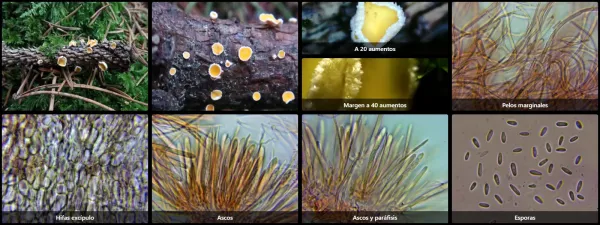
Ascocarp pseudostipitate and of minute size; the most developed specimens barely reach 3 to 4 mm in diameter, it being very common to find them even smaller. Initially spherical in shape, but soon becoming cup-shaped. The external surface is entirely covered with white hairs that impart this color, which extend to cover the margin as well. This margin is often slightly involute, especially when the specimens are young.
Hymenium lining the inner surface, which is completely smooth and therefore lacks the external pubescence. The beautiful yellow color of this entire internal surface, sometimes with an orange tint, is striking.
Stipe evident if examined closely, for example with a hand lens; otherwise it may go unnoticed. It is concolorous and very small.
Flesh insignificant given the minute and non-fleshy nature of this Ascomycete, with no distinct odor nor remarkable taste.
Habitat:
It is a fairly common species, but in most cases goes unnoticed due to its small size. It may appear at any time of year, but is more abundant during spring. It always fruits on dead wood of various conifers, such as pines or spruces.
Observations:
The genus Lachnellula is closely related to the genus Lachnum, from which it differs only by minor microscopic characteristics, primarily related to the paraphyses. The similar species Lachnellula willkommii fruits on larches; under the microscope they are easily distinguished, as its spores are enormous compared to those of the species described here. The species Arachnopeziza aurelia, of similar size, however has golden-yellow external hairs.