
Laccaria laccata
Taxonomy
Main synonym
Common names
Lacaria lacada, lakaria arrunt, pinpinella rosada, cogomelo lacado.
Geographic references:
Interactive map with data from GBIF.


Morphological Features:
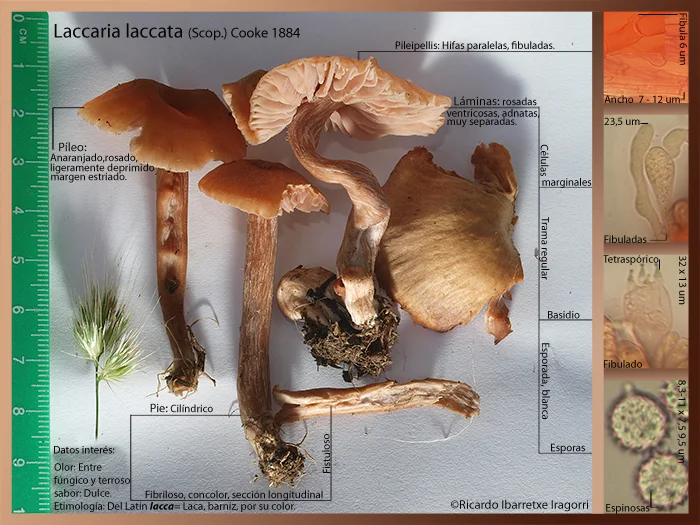
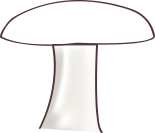
Pileus with a diameter reaching up to 5 cm at most; convex for much of its development, eventually flattening out, and old specimens may even exhibit a slightly depressed cap. The cuticle is finely scaly when young but soon becomes smooth and glabrous after rain. It has a characteristic reddish-brown color that fades considerably due to its hygrophanous nature, adopting a paler ochraceous tone. The margin is radially striate by transparency and may become markedly undulate in older specimens.
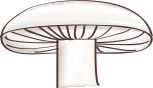
Lamellae adnate to slightly decurrent, very pale pink in color, relatively distant from one another and interspersed with lamellulae. They are quite thick and often appear powdery due to the abundant white spore deposit resting upon them.
Stipe generally disproportionately elongated relative to the pileal diameter, though shorter in some of its numerous varieties. It is longitudinally sulcate and quite fibrillose, similar in color to the pileus or slightly darker, with a whitish mycelial attachment at the base.
Flesh scant and thin, similar in color to the lamellae (pale pink), slightly more fibrous in the stipe. The odor is faintly fungoid, and the taste is mild and sweet.
Habitat:
This is a fairly cosmopolitan species that occurs equally across diverse habitats, including coniferous and deciduous forests, meadows, and even urban gardens. It is therefore a very common and abundant mushroom that fruits nearly year-round following rainfall. It generally grows in gregarious clusters, although isolated specimens can occasionally be found, this is not the norm.
Observations:
Species within the genus Laccaria exhibiting reddish-brown or ochraceous coloration are quite similar; some can be distinguished macroscopically. For instance, Laccaria bicolor possesses a violaceous mycelium, a coloration that extends to the stipe base. Laccaria proxima is macroscopically indistinguishable, but its spores are markedly larger.
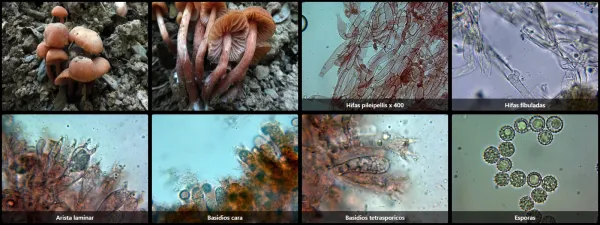
Microscopy of Laccaria laccata