
Kretzschmaria deusta
Taxonomy
Main synonym
Common names
Ustulina quemada, zarakar-kimo.
Geographic references:
Interactive map with data from GBIF.



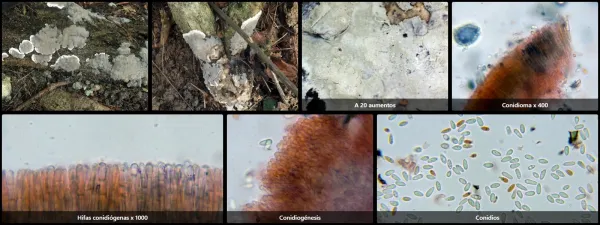
Morphological Features:
Fruiting body formed by a crust-like structure adhered to the substrate, which may protrude from it by slightly less than 1 cm. In its initial developmental stage, it appears as a series of separate individuals, whitish or gray in color and small in size, with margins raised higher than the center, which serves as the point of attachment to the substrate. They gradually darken from the center outward while expanding and tending to coalesce, forming crusts that can reach up to 10 cm in diameter in some cases. It is typically recognized in this state, exhibiting a black coloration that gives the impression of being charred, and it may even exude a soot-like substance. As is common in some Ascomycota, it exhibits two morphological forms: an initial conidial stage and a subsequent ascogenous (sexual) stage.
Hymenium immersed internally, where small cavities containing asci are visible; these are released to the exterior through minute openings known as ostioles.
Flesh hard, with a consistency resembling charcoal, virtually odorless.
Habitat:
A relatively uncommon species that appears in spring during its conidial phase, with mature individuals in the ascogenous phase typically found in autumn. Fruiting occurs on the wood of broadleaf trees, with a particular preference for beech.
Observations:
This fungus is characterized by forming crusts with a charred appearance on beech wood; its considerable size distinguishes it from fungi of the genus Hypoxylon. The most similar species is likely Annulohypoxylon multiforme, which also forms irregularly shaped crusts on wood, although its coloration is not as intensely charcoal-black, and its primary habitat consists of birch trees.