Inocybe lacera
Taxonomy
Main synonym
Common names
Not available
Geographic references:
Interactive map with data from GBIF.





Morphological Features:
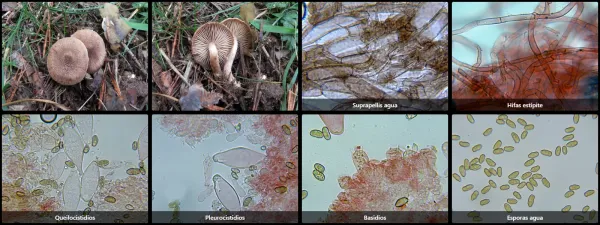
Pileus with a diameter ranging from 3 to 5 cm in mature specimens, bell-shaped when young, then becoming convex and tending to flatten, though not completely, retaining an obtuse umbo at the center. The surface is dark brown, especially towards the center, fading towards the margin, and may exhibit a yellowish tint upon drying. Cuticle notably fibrillose to tomentose, becoming scaly with age. Margin regular with remnants of the veil, particularly in young specimens.
Lamellae adnate, very pale initially, quickly turning brownish, while the lamellar edge remains paler. They are rather widely spaced compared to other species of its genus and include lamellulae.
Stipe cylindrical, brown with a slightly paler base, longitudinally fibrillose and tomentose, bearing whitish veil remnants in young specimens that tend to disappear with age.
Flesh thin, whitish to ochraceous, tougher and more fibrous in the stipe. Taste mild and slightly sweet; odor spermy.
Habitat:
Although it shows a certain preference for acidic soils, it is a geographically widespread species. Fruiting occurs in almost all types of forests during summer and especially autumn, on sandy soils or along road verges. It is quite frequent.
Observations:
Toxic species containing high levels of muscarine, in proportions similar to white Clitocybe species and other members of its own genus. The variability of the species has given rise to several varieties; furthermore, many other similar species exist, such as Inocybe lanuginosa, Inocybe hystrix, or Inocybe cincinnata, to name a few examples, making microscopic examination necessary for accurate identification.