Inocybe geophylla
Taxonomy
Main synonym
Common names
Not available
Geographic references:
Interactive map with data from GBIF.




Morphological Features:
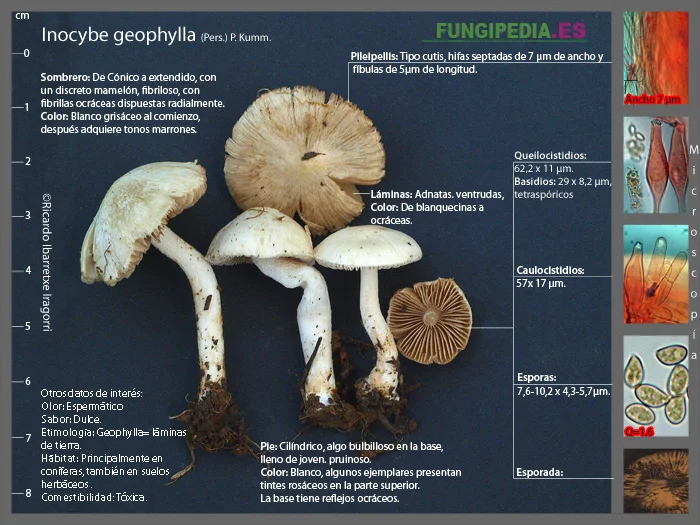
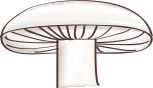
Pileus small in size, rarely reaching 5 cm in diameter, conical in its early stage, later convex and finally flattened, but retaining a very prominent acute umbo at the center. In the type species it is pure white, although a variety with lilac tones exists. Its surface is silky-fibrillose, especially when young, and appears very dry. It is not uncommon to find remnants of the partial veil at the margin.
Lamellae adnate to slightly notched, sinuous and with lamellulae, dirty white or grayish before spore maturity, later ochraceous or brownish.
Stipe cylindrical and elongated, white in color, finely silky, with a bulbous thickening at the base. It may yellow at the mycelial attachment and is hollow from an early stage. Remnants of the partial veil in the upper third are fugacious, tending to disappear rapidly.
Flesh soft, thin and white in color, with a spermy odor and sweet taste.
Habitat:
It is undoubtedly one of the most frequent and abundant Inocybe species. We have observed it in practically every type of habitat, from larch forests, where it forms carpets, to broadleaf woods, fruiting preferably during autumn.
Observations:
This mushroom is notably toxic due to its high concentration of muscarine, similar to that found in some white Clitocybe species. Symptoms of this poisoning include profuse sweating and severe gastrointestinal distress, which in extreme cases can lead to convulsions. It is a mushroom that can be recognized with relative ease, which is somewhat unusual for its genus.
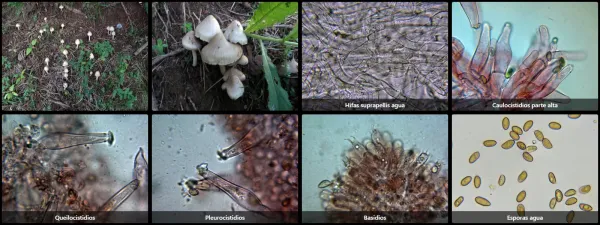
Microscopy of Inocybe geophylla