
Imperator luteocupreus
Taxonomy
Main synonym
Common names
Not available
Geographic references:
Interactive map with data from GBIF.


Morphological Features:
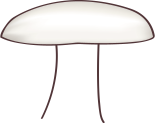
Pileus of considerable size, reaching up to 20 cm in diameter. Hemispherical when young, becoming convex, but never fully flattening out. The color is highly variable; it emerges pale yellow but quickly shifts to orange and then reddish, with nuances of various colors, predominantly coppery tones. The cuticle is smooth and dry, occasionally glossy but not viscid. The margin is markedly overhanging and inrolled, forming a characteristic undulation in older specimens. Bruises blue intensely upon handling.
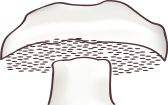
Tubes adnate or more commonly free, yellow in color, becoming olivaceous with age. Bruise blue when cut.
Pores typically red, though they may be yellow at emergence, and even in adult specimens can appear orange or yellowish near the margin. Bruises distinctly blue-green.
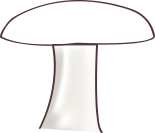
Stipe robust and stout when young, later becoming cylindrical or clavate, yellowish in background but overlaid with a fine orange to red reticulation. The base typically turns wine-red.
Flesh yellow, bruising intensely blue upon cutting, then fading after a short while and developing reddish tones after about an hour. Wine-red at the stipe base. Thick and firm, with a slightly acidic taste and an unpleasant, though not overpowering, odor.
Habitat:
A fairly thermophilic species that typically emerges concurrently with dark-capped boletes. We have consistently located it during summer and early autumn, associated with broadleaf forests, observed under oaks and beeches in the province of Álava, though it is more common in southern Iberia.
Observations:
This species is suspected to be toxic, and therefore its consumption is not recommended. It belongs to a complex of highly similar species that are difficult to classify; a detailed taxonomic analysis warrants a separate section. The species most closely resembling it may be Rubroboletus legaliae and Imperator rhodopurpureus, though many others exist.