
Hypsizygus ulmarius
Taxonomy
Main synonym
Common names
Seta de olmo.
Geographic references:
Interactive map with data from GBIF.



Morphological Features:
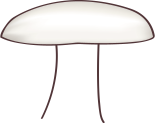
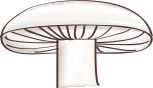
Pileus that can reach notable dimensions, usually with a diameter between 5 and 10 cm, but specimens approaching 20 cm can be found. Its shape is convex for much of its development, tending to flatten out at maturity, rarely depressed. The surface is glabrous, with variable coloration ranging from initial light tones, sometimes almost whitish, to a pale ochraceous or hazel color at maturity; it generally lacks a uniform color, instead showing zones of different shades. The cuticle is separable and tends to crack, forming areolate zones, especially under low humidity conditions. The margin is strongly involute in young specimens, incurved in adults, and rarely extended.
Lamellae adnate and moderately crowded, white to slightly cream-colored; they are typically thick-fleshed and not very broad.
Stipe central or eccentric; solitary specimens typically have a central stipe, while those arising in clustered groups are eccentric. Generally short and solid, cylindrical or tapering towards the base, initially white with a tendency to acquire tones similar to the pileus in age.
Flesh dense and compact, white in color, with a somewhat elastic consistency. It has a farinaceous odor in young specimens that becomes rancid in age, and a mild, also farinaceous taste.
Habitat:
This is a species almost exclusively associated with elms, though it has occasionally been reported on poplars as well. It exhibits lignicolous growth, fruiting on trunks, stumps, or dead wood of elms, but also on living trees. It may grow solitarily or in clustered groups, with autumn being its preferred season of appearance. This species should be considered rare due to its exclusive habitat and the marked decline of this tree species throughout the Iberian Peninsula.
Observations:
Young specimens constitute an acceptable edible, appreciated in areas where it fruits; when old, they become somewhat tough and their flavor becomes stronger. Given the described morphological characteristics and its exclusive habitat, this species is nearly unmistakable. For a considerable time, it was believed that the species Hypsyzigus tessulatus, widely cultivated in places such as China where it is known by the common name Shimeji, was the same species; however, studies conducted by Redhead in 1986 revealed that they are distinct species. Due to the elastic texture of the flesh, they bear a strong resemblance to species of the genus Lyophyllum; however, these do not grow on wood.