
Hypholoma lateritium
Taxonomy
Main synonym
Common names
Hifoloma color ladrillo, suge-ziza teilakolore, bolet de pi rogent.
Geographic references:
Interactive map with data from GBIF.


Morphological Features:
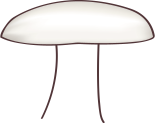
Pileus frequently exceeding 5 cm in diameter at maturity, initially globose, then evolving from hemispherical to convex, and finally plano-convex. The surface is a striking brick-red in the central zone, fading towards the margin to more yellowish or whitish tones. Cuticle smooth or occasionally scaly, velvety to the touch in young specimens, later glabrous. The margin is reflexed and quite regular, without major undulations nor striations; it is common to find remnants of a yellowish veil not only on the margin but also scattered as flakes over the rest of the pileus, especially in younger individuals.
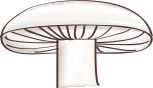
Lamellae adnate and quite crowded; initially pale, later becoming greyish-violet, and turning brownish-purple after sporulation. In this final stage, the edges are typically lighter in color than the rest of the lamellae.
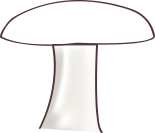
Stipe elongated, cylindrical, and robust in appearance; yellowish in color, but becoming brownish from the base upwards. It is fistulose and slightly fibrillose, typically bearing cortinate remnants of a yellowish veil that tend to disappear or become stained with the spore print color.
Flesh thicker than that of its congeners, yellowish except at the stipe base where it is ochraceous. The odor is not very strong but somewhat unpleasant, and the taste is slightly bitter, with a bitterness that is sometimes delayed and faint.
Habitat:
This species fruits on wood from various trees or stumps; it is frequently observed on hardwoods, particularly beech and oak, but is much rarer on conifer wood, where we have never encountered it. It is most common in autumn but may occasionally fruit in other seasons. It almost always grows in numerous fasciculate clusters.
Observations:
Together with Hypholoma fasciculare and Hypholoma capnoides, it forms the trilogy of common fasciculate hypholomas. It is undoubtedly the most robust of the three, characterized by the brick-red coloration of the pileus center and its yellowish veil. It differs from the aforementioned species in that the first possesses greenish lamellae and markedly bitter flesh, whereas distinguishing it from the second is somewhat more challenging, as the latter displays more yellowish tones and a preferential habitat on conifer wood. We have noted that the bitterness of the flesh in this species is a variable, conditioned trait; at times it is distinctly bitter, while at other times the flesh is slightly sweet yet unpleasant-tasting.