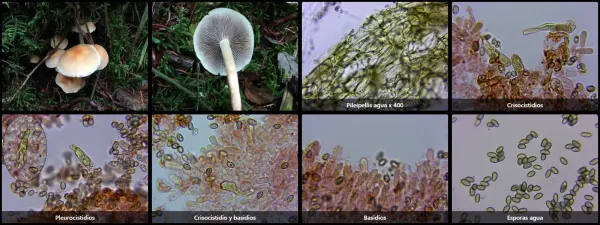
Hypholoma capnoides
Taxonomy
Main synonym
Common names
Hifoloma de láminas grises, suge-ziza gozo, psilocibe doce da madeira.
Geographic references:
Interactive map with data from GBIF.




Morphological Features:
Pileus reaching over 5 cm in diameter in adult specimens; initially globose in the early stages of development, becoming hemispherical and finally plano-convex. The cuticle is fairly uniform in a yellowish-ochre color with orange tints, only the central zone being darker than the rest; it is smooth and glabrous, shiny in the rain but by no means viscid. Margin regular, barely undulate; in young specimens it may show remnants of the veil, but these disappear rapidly.
Lamellae adnate and quite crowded, pale gray when young, then becoming a more pronounced gray, from which they transition directly to purplish-brown upon maturation as spores are deposited on them, staining them; they are never greenish.
Stipe disproportionately elongated relative to the pileus diameter, central and cylindrical, generally curved due to the fasciculate growth habit of the species. It is fistulose and fibrillose, pale towards the apex and somewhat more ochraceous at the base, which is usually slightly radicate.
Flesh not very thick, whitish in color with a somewhat elastic consistency. It has barely perceptible odor and a sweet taste.
Habitat:
This is a saprotrophic species with a fasciculate growth habit that fruits on degraded wood or stumps of various trees, showing a certain predilection for coniferous wood, although it is not exclusive to them. If environmental conditions are suitable, it can appear practically year-round; it is frequent but not as common as other fasciculate hypholomas.
Observations:
Among fasciculate hypholomas, it is the only one with sweet flesh and non-toxic; however, due to its toughness and striking resemblance to toxic species, consumption is not recommended. Hypholoma fasciculare is very similar, but has greenish lamellae, very bitter flesh, and a foul odor. Hypholoma lateritium, which is more fleshy, has a brick-red pileus center and clay-colored lamellae.