
Hymenostilbe muscaria
Taxonomy
Main synonym
Common names
Not available
Geographic references:
Interactive map with data from GBIF.
Morphological Features:
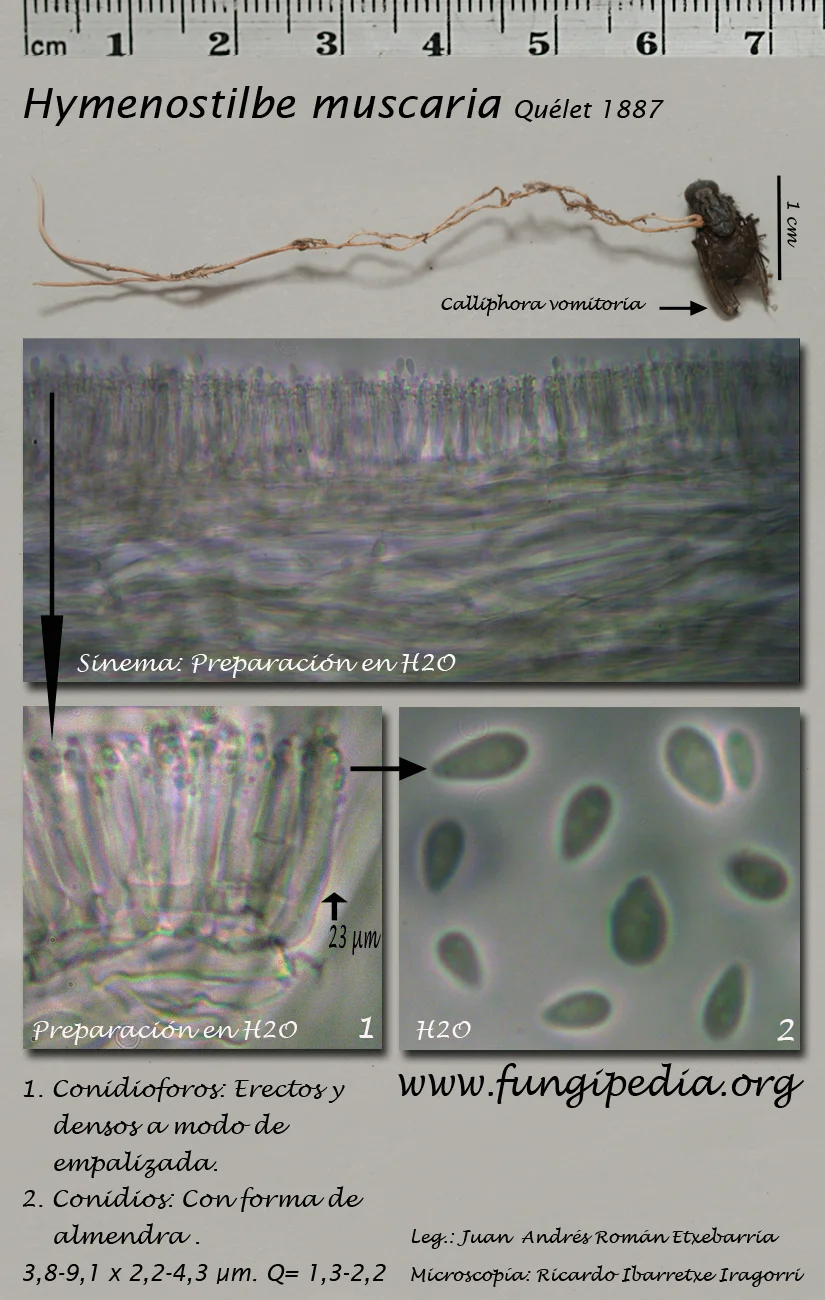
Carpophore with a slender and highly stylized appearance, practically filiform; however, it does not appear erect but rather highly sinuous or undulate. It typically reaches a remarkably tall height relative to its extreme thinness; in our collection, specimens reached up to 6.5 cm in length by merely 2 to 3 mm in width. The entire structure exhibits a fairly uniform yellowish-ochre color, becoming distinctly pale ochre upon drying of the carpophore. Its surface is smooth and glabrous, becoming pulverulent upon maturation as a result of sporulation. The apex of this species typically tapers to an acute point, lacking any distinct head or cap-like structure.
Hymenium which in this case is located on the external surface of the conidioma, completely smooth; as an anamorphic form of an Ascomycete, it produces abundant conidia (see microscopic data).
Stipe absent as such; no evident differentiation between various parts of the conidioma is observed, despite the basal region being sterile.
Flesh practically nonexistent given the extreme thinness of this species, with no notable odor or flavor detected.
Habitat:
This is a fungus parasitic on flies; once parasitized, the fly dies and the fungal fruiting body emerges from within it. Conidia are released from this structure and can re-parasitize other flies, thus completing the reproductive cycle. In our collection, the fungus was parasitizing Calliphora vomitoria (the flesh fly), also colloquially referred to as "moscón". This species is characterized by ovipositing on carcasses, contributing to the decomposition of their flesh, and is well-known to forensic entomologists because larval development studies are used to estimate the time of death.
Observations:
Conidioma of the synnema type, anamorph of Ophiocordyceps forquignonii ss. auct. = Ophiocordyceps ditmarii. Until recently, most authors accepted that fungi parasitizing flies in their sexual phase correspond to Ophiocordyceps forquignonii, while those parasitizing wasps correspond to Ophiocordyceps ditmarii or Ophiocordyceps sphecocephala. In 2011, Christian Lechat sequenced the DNA of both species, concluding that they represent a single taxon. The most striking macroscopic difference compared to the teleomorphic forms of the fungus, such as Ophiocordyceps sphecocephala, is the presence in the latter of a distinct head-like structure at the apex.
Microscopy of Hymenostilbe muscaria