
Hymenoscyphus monticola
Taxonomy
Main synonym
Common names
Not available
Geographic references:
Interactive map with data from GBIF.



Morphological Features:
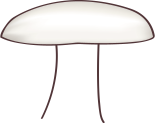
Fruiting body very small; the diameter of specimens of this species ranges from 2 to 5 mm. Initially turbinate in shape, i.e., resembling a typical funnel or tornado form, but flattens over time to become discoid, appearing directly attached to the substrate. The external surface is smooth and shiny, completely glabrous, pale yellow in color, occasionally becoming diffuse under excessive moisture and taking on a translucent appearance.
Hymenium completely smooth and shiny, yellow in color, with intensity varying according to its developmental stage. The ascospores are notably septate.
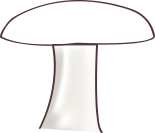
Stipe Slightly paler in color than the rest of the ascocarp. In the group of disc-shaped Ascomycetes (Discomycetes), the outer portion of the hymenium is termed an exciple; if its structure remains uniform along its entire length, it is not technically considered a stipe. We understand this to be why some authors do not reference it; however, for macroscopic descriptive purposes, we will refer to it as a stipe.
Flesh Insignificant in amount, with a slightly gelatinous or waxy consistency; pale yellow to whitish in color. Taste and odor are unremarkable.
Habitat:
Species documented on branches of Quercus; its occurrence on other tree species cannot be ruled out. It particularly requires a high degree of moisture, and is therefore typically found in waterlogged areas or near springs and streams. These specimens were collected near a spring on an oak branch in September, despite the species being more characteristic of late autumn. It is quite rare and infrequent.
Observations:
It would be entirely impossible to identify species of the genus Hymenoscyphus without the invaluable aid of a microscope. This particular species is characterized by its habitat in very moist areas on branches of Quercus, as well as by its ochraceous, septate spores with up to three septa. Other similar species, but occurring on remains of Fagus sylvatica, are Hymenoscyphus inmutabilis and Hymenoscyphus serotinus; however, neither possesses septate spores.