
Hymenoscyphus immutabilis
Taxonomy
Main synonym
Common names
Not available
Geographic references:
Interactive map with data from GBIF.
Morphological Features:
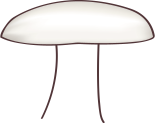
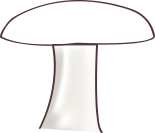
Carpophore stipitate, of small size, with an approximate diameter of 2 to 3 mm. Initially more or less convex, but may become flattened or discoid. The surface is lemon-yellow, completely smooth and glabrous, with a shiny appearance, especially when wet, but not viscid. The margin is entirely regular and rounded, also smooth and lacking hairs.
Hymenium or fertile part of the carpophore, of the same color as the rest or slightly paler, and equally smooth and lacking hairs.
Stipe short, paler in color than the rest but perfectly defined as such, giving the whole a yellow pin-like appearance. It is also smooth and glabrous.
Flesh insignificant due to the small size of the specimens, waxy or slightly gelatinous in appearance and yellow in color. Its odor is faint and its taste mild.
Habitat:
This is a species that grows on decaying wood of various broadleaf trees. The collected specimens were found in the beech forest of Carrales (Burgos), on detached bark of Fagus sylvatica. We have observed it in autumn, though its occurrence at other times of the year cannot be ruled out. It is a very rare species.
Observations:
It is absolutely impossible to separate this species from others of the same genus without the aid of a microscope. In the same habitat, more common species than this one occur, such as Hymenoscyphus calyculus or Hymenoscyphus serotinus, whose macroscopic differences with respect to the species described here are practically nil. Bisporella citrina is also very similar, bearing sessile carpophores or with a more rudimentary stipe.