Hymenoscyphus fructigenus
Taxonomy
Main synonym
Common names
Not available
Geographic references:
Interactive map with data from GBIF.




Morphological Features:
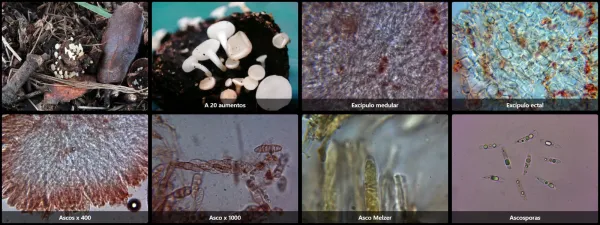
Carpophore very small in size, composed of a pileus and a stipe, the former rarely exceeding 5 mm in diameter. They are more or less cup-shaped, especially at the base, becoming practically flattened with age. Their color is somewhat variable, commonly whitish, but may also be dirty yellow or watery yellowish-cream, depending on their moisture content. The surface is completely smooth and glabrous.
Hymenium smooth and glabrous, matching the color of the rest of the ascocarp, though sometimes more distinctly cream-colored. Produces guttulate ascospores measuring up to 20 × 5 μm.
Stipe disproportionately elongated, similar in color to the rest of the carpophore and equally smooth.
Flesh insignificant; the fruitbody is so minute that it possesses virtually no flesh, with a faintly perceptible odor and an unremarkable taste.
Habitat:
This aspect is particularly noteworthy for this species, as it fruits on the fruits or cupules of various trees. We commonly observe it on beechnuts, but it also occurs on oak fruits or hazelnuts. It may appear in spring, but is more frequent during autumn, being generally a relatively common species.
Observations:
Recognizing this Ascomycete is not difficult due to its peculiar habitat; most species within this genus fruit on stems or branches, and a whitish color is also uncommon in the genus. The absence of hairs distinguishes Hymenoscyphus from other macroscopically similar species such as Dasyscyphella nivea. Cudoniella aciculare is very similar, but it fruits on decaying beech wood rather than on beechnuts, and also exhibits microscopic differences.