
Hymenogaster luteus
Taxonomy
Main synonym
Common names
Himenogaster amarillo
Geographic references:
Interactive map with data from GBIF.



Morphological Features:
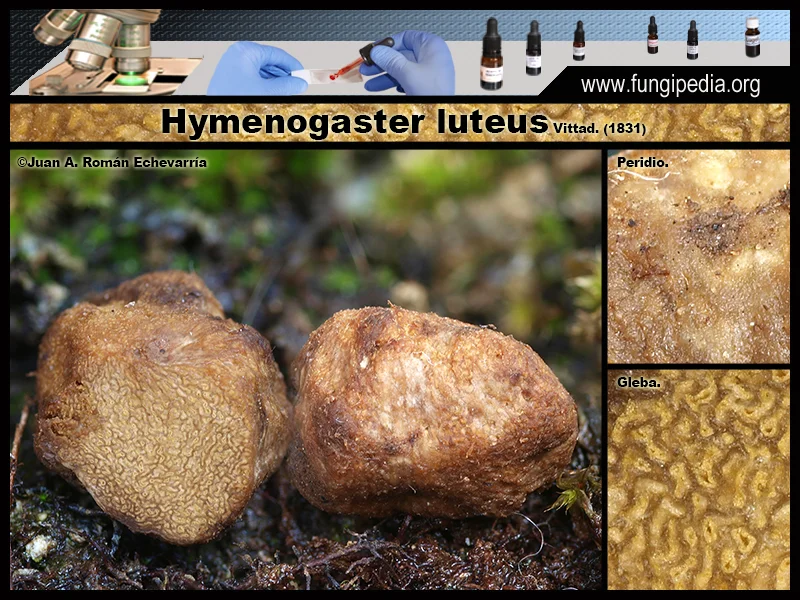
Basidiocarp truffle-shaped, i.e., with the tuberculate form typical of most hypogeous species, and exhibiting considerable variation; some specimens are quite rounded, others oblong or flattened, with not overly pronounced protuberances, neither lobed nor possessing cavities. Its size is small; the diameter of collected specimens ranged from 0.5 to 2 cm, reaching at most 2.5 cm. When young, specimens are whitish, acquiring ochraceous tones with development, occasionally with yellowish hues.
Peridium initially somewhat pruinose or fibrillose, becoming smooth and glabrous; white in younger specimens, acquiring ochreous or yellowish tones with age, and staining brownish upon handling. It is indeed thin and not separable from the gleba.
Gleba compact, generally composed of very small, labyrinthine locules; initially whitish, then yellow, and finally ochre-yellow. The veins are very subtle; a distinctly pale, sterile venous zone is not differentiated in species of this genus, as occurs in other genera of hypogeous fungi.
Flesh somewhat soft or spongy in texture; when young it has a sweetish odor, but with maturity it intensifies and becomes somewhat unpleasant and complex; the taste is unremarkable.
Habitat:
This is a hypogeous species that develops underground, and typically fruits on calcareous soils; various habitats have been reported for it, both under broadleaf trees and diverse conifers. The specimens collected that serve as the basis for this study were located in the province of Bizkaia and in La Rioja, fruiting under Quercus ilex. This species can be found practically year-round, perhaps except during the hottest part of summer. The scarcity of surveys for hypogeous fungi means we do not truly know the abundance or rarity of certain species; it is highly likely to be a frequent species.
Observations:
We are dealing with a species characterized by its white peridium that stains upon handling, its yellow gleba, and microscopically by the variety of spore shapes, predominantly fusoid, but also adopting unusual forms. It is without culinary value. Hymenogaster luteus var. subfuscus Soehner differs from the type species by having larger locules in the gleba, which is never yellow but remains white until turning ochraceous. It may be confused with Hymenogaster bulliardii, which has citriform spores that are less elongated than those of our species, and possesses a distinct papilla.
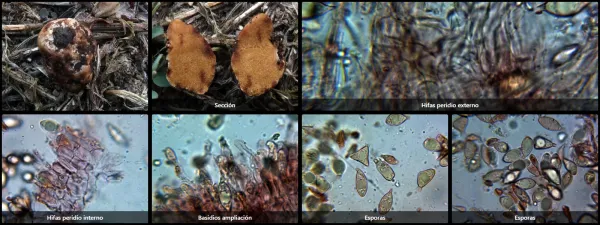
Microscopy of Hymenogaster luteus