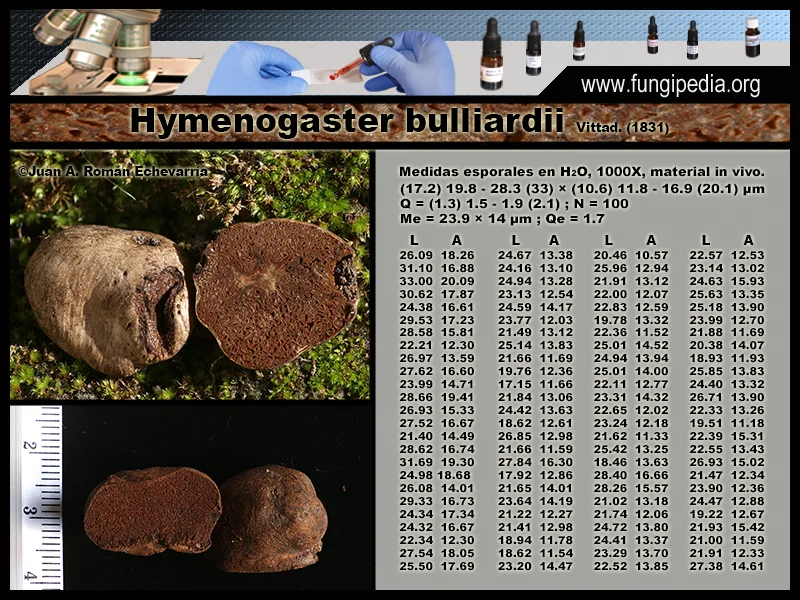

Hymenogaster bulliardii
Taxonomy
Main synonym
Common names
Not available
Geographic references:
Interactive map with data from GBIF.
Morphological Features:
Basidiocarp truffle-like in shape, resembling a small tuber with a fairly compact and hard appearance, sometimes more or less spherical, though usually adopting more irregular forms with various prominences or lobes. This is a small-sized species; the collected specimens had a maximum diameter ranging from 1 to 2.5 cm, although slightly larger specimens are referenced, around 3 to 4 cm. It is characterized by considerable color variability; within a single collection, nearly white specimens may be found alongside others with dark ochre tones and even blackish hues.
Peridium smooth and glabrous, with a rather dry appearance, initially whitish but developing considerable chromatic variability upon maturity, ranging from ochre tones to nearly blackish, even variegated within a single specimen. Composed of an exoperidium of parallel hyphae arranged in a cutis, and a more intricate endoperidium with interwoven hyphae; this configuration makes the peridium difficult to separate from the gleba, remaining attached even in the most mature specimens. Relatively thick, it can measure approximately 250 to 300 μm in width.
Gleba fairly compact in appearance, with a color ranging from yellowish-ochre to dark brownish-black, developing dark stains upon cutting and handling. It is composed of small cells tightly packed together, especially in young specimens where they are barely discernible; upon maturity, they open slightly and become more visible to the naked eye. It possesses a poorly developed columella. Microscopically, it produces smooth spores predominantly lemon-shaped, but with a prominent appendage at the junction with the basidium, as well as a prominent apical region, along with thick walls. The presence of aberrantly shaped spores is common in this species.
Flesh essentially absent beyond the gleba itself; the odor of young specimens is faint, but as is typical, it develops a stronger, sometimes unpleasant odor upon maturity.
Habitat:
This species shows a preference for calcareous soils and generally fruits in holm oak, oak, or hazel woodlands from late autumn to spring, allowing it to be defined as an eminently winter species. It most commonly grows hypogaeously or semi-hypogaeously, although specimens emerging entirely to the surface have been found. This study is based on two collections of the species: one in the Bureba region of Burgos in January under holm oak (Quercus ilex), and another in the province of Álava, also in winter, but in this case located under oak.
Observations:
This species falls within a section of the genus Hymenogaster that includes taxa with smooth, non-ornamented spores lacking a perispore; the type species of this section is Hymenogaster luteus, which is morphologically distinct from the species described here due to its yellowish gleba. The genus is highly complex and encompasses over 100 species; however, only about 7 or 8 are included in this section, which somewhat facilitates identification. No species within this genus holds culinary interest; they are generally hard and possess an unpleasant odor and flavor. Unlike true truffles, these are hypogeous Basidiomycetes. In the case of this genus, they grow quite close to the surface and frequently emerge, although they are typically located using dogs, as in our case.
Microscopy of Hymenogaster bulliardii