
Hygrophorus russula
Taxonomy
Main synonym
Common names
Hygróforo escarlata, ezko gibel-gorri, escarlet, carlet, seta cardenal.
Geographic references:
Interactive map with data from GBIF.
Morphological Features:
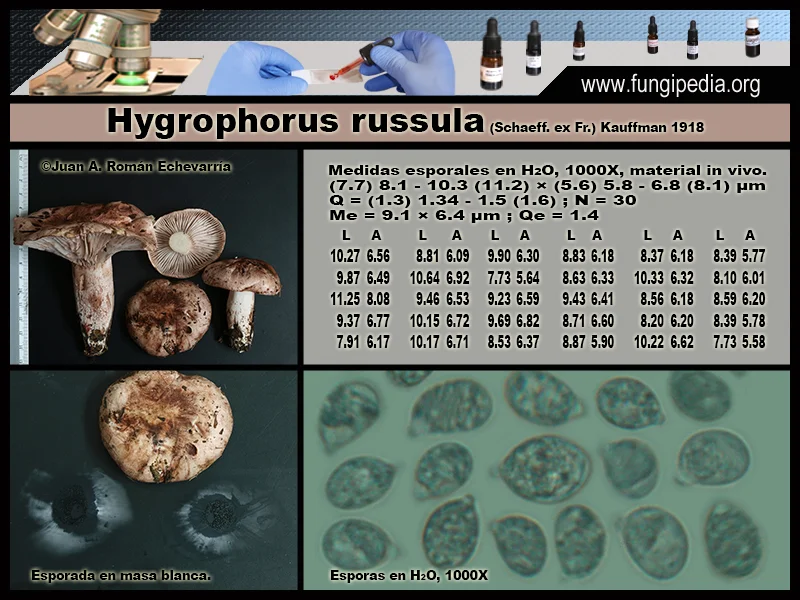
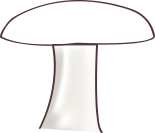
Pileus with a highly variable diameter; some adult specimens barely reach 4 cm while others exceed 10 cm. Initially hemispherical, later becoming convex to flattened, and even slightly depressed in age. Cuticle shiny when wet, scarcely viscid, rather dry in most cases, cream-colored at the base but blotched with vinous-red or pinkish maculations, a color that generally predominates; easily separable from the flesh. Margin incurved for much of the development, later undulate and less tinged with reddish hues than the rest.
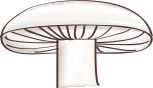
Lamellae adnate to slightly decurrent, of medium density, crowded compared to other species of the genus. Whitish in color but with a marked tendency to stain the same color as the pileal cuticle; practically vinous-red in age. Quite broad, producing a white spore print.
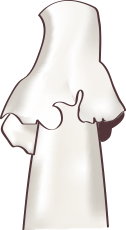
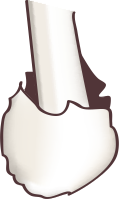
Stipe cylindrical and proportional in size to the pileus, occasionally somewhat attenuated at the base or even radicate at times. Solid and robust in appearance, whitish in color but tending to stain vinous-red from the base upwards. Furthermore, it is covered with longitudinally arranged fibrils of that same vinous-red color.
Flesh thick and compact, white in color, with a fibrous consistency, slightly tinged pinkish when cut. Odor not noteworthy; taste markedly bitter.
Habitat:
This is a late-appearing species that favors cool temperatures, like most of its congeners. It typically fruits in late autumn and even early winter in some regions. It usually fruits under various deciduous trees and is not exclusive to any particular soil type, although it is notably more abundant in calcareous holm oak woodlands than in other forest types. It generally appears solitary or in small groups and is quite frequent.
Observations:
Consumed in some regions, particularly Catalonia, although its culinary quality is limited due to the slightly bitter flesh and even more so the cuticle. It is characterized by the vinous-red tones that permeate all parts of the fruit body, its robust stature, and the aforementioned taste. It is often confused with Russula species, hence its specific epithet; however, Hygrophorus species do not fracture like chalk but possess fibrous flesh. Furthermore, it may be confused with other Hygrophorus species, such as Hygrophorus arbustivus, none of which exhibit the characteristic vinous-red tones of this species.
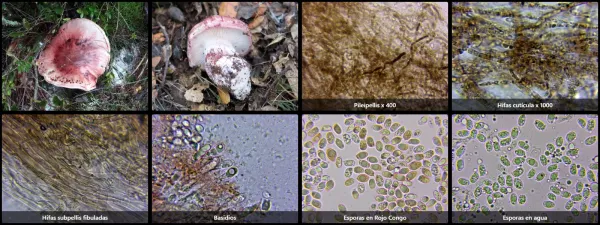
Microscopy of Hygrophorus russula