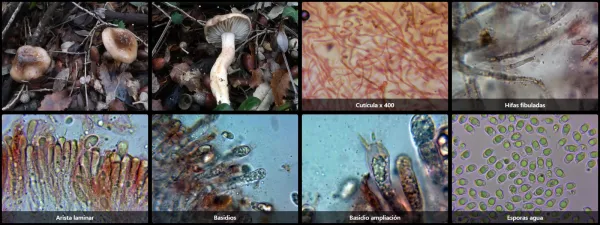

Hygrophorus persoonii
Taxonomy
Main synonym
Common names
Hygroforo oliva y blanco, ezko kolorebiko, llenega.
Geographic references:
Interactive map with data from GBIF.
Morphological Features:
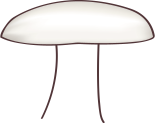
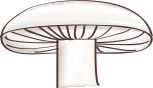
Pileus of medium size; the diameter of adult specimens generally ranges between 4 and 8 cm, occasionally slightly larger. Initially perhaps bell-shaped, soon becoming convex and finally flattened, maintaining a raised center in the form of an obtuse umbo. Cuticle typically viscous and glutinous in wet weather, completely separable from the flesh, dark brown in the central zone—a color that remains unchanged with development—however variable elsewhere, with lighter brown tones and olivaceous tints in young specimens. It usually presents a very pale marginal zone, cream or even whitish. Margin decurved and fairly regular.
Lamellae adnate to subdecurrent, white throughout development, moderately spaced though not as widely as in other species of its genus, with abundant short lamellulae near the margin numbering similarly to the full lamellae; edge regular and entire.
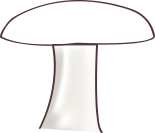
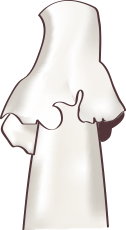
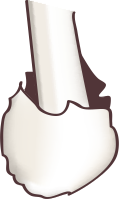
Stipe generally elongate relative to the pileus, although in certain geographic areas a variety with a shorter stipe occurs. White in background color; pruinose and covered with concolorous granules in the upper third, and covered with brownish glutinous scales in the lower two-thirds. Cylindrical and solid.
Flesh compact, white, and unchanging on cutting; spongy in texture, with an imperceptible odor and a mild, pleasant taste.
Habitat:
This species is associated with broadleaf forests and forms ectomycorrhizae with trees such as holm oak (Quercus ilex), cork oak (Quercus suber), or various oak species such as Pyrenean oak (Quercus pyrenaica); our collection was made in a Quercus robur forest. It is an acidophilic species that fruits primarily during autumn, rarely solitary, and more commonly occurring in groups or small clusters.
Observations:
Despite its viscosity, it is an acceptable edible; it is advisable to remove the cuticle prior to preparation. It serves as a good accompaniment for all types of stews, though not reaching the excellence of Hygrophorus latitabundus, a species with which it is often confused. To differentiate between the two species, one must first consider the habitat, as Hygrophorus latitabundus is native to calcareous pine forests rather than acidophilic broadleaf woods; additionally, it tends to be larger in stature and its pileus exhibits more grayish tones. Another similar species is Hygrophorus olivaceoalbus, which has a slender and stylized stipe. It is difficult to confuse the species presented here with any toxic ones.