

Hygrophorus gliocyclus
Taxonomy
Main synonym
Common names
Llenega blanca, mocosa, llenega groga.
Geographic references:
Interactive map with data from GBIF.




Morphological Features:
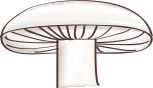
Pileus generally ranging from 3 to 7 cm in diameter, initially globose, then convex with a slight umbo, and finally expanded. Even when fully developed and expanded, it almost always retains an incurved margin, which is also thin. Yellowish in color, especially at the center, becoming paler, almost whitish, towards the margin. The surface is viscid in dry weather and glutinous when wet, separable from the pileal flesh.
Lamellae cream-colored, widely spaced, arcuate, and decurrent on the stipe, rather thick.
Stipe cylindrical but slightly attenuated at the base, same color as the pileus and also viscid, though much less so. May exhibit a viscid pseudoring formed by adhering remnants of the partial veil, although it is not commonly present as it tends to disappear. Solid and hard, firm.
Flesh thick and firm, white in color, with a weak, insignificant odor, and a sweet, mild taste.
Habitat:
A species that fruits during autumn in pine forests. It is frequent and abundant in some areas.
Observations:
An edible species appreciated in some areas of the Iberian Peninsula; in some places it is called "llenegua blanca," a name that in other regions refers to Hygrophorus eburneus, distinguishable from it by being more whitish and aromatic, and by its habitat under broadleaf trees. Another species that may resemble it somewhat is Hygrophorus chrysodon, whose stipe is decorated with conspicuous yellow granulations.