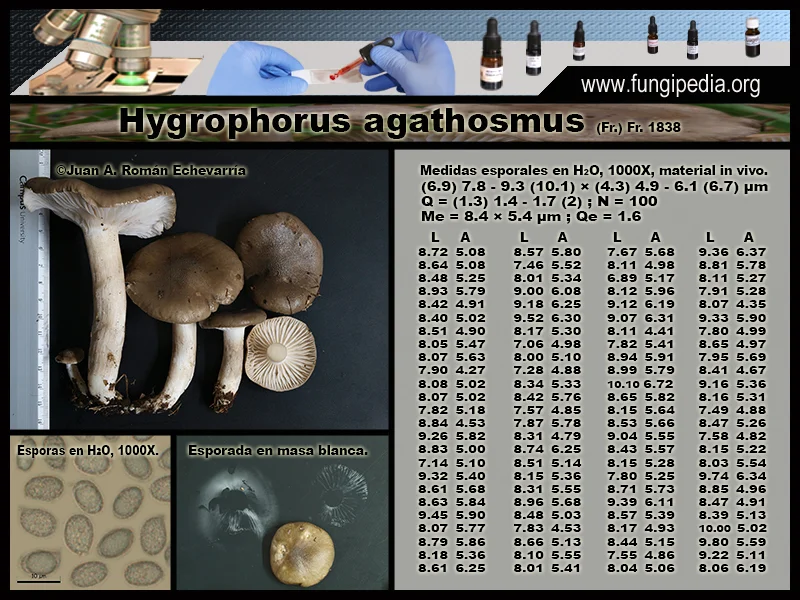

Hygrophorus agathosmus
Taxonomy
Main synonym
Common names
Higróforo de olor a almendras, ezko almendrausain.
Geographic references:
Interactive map with data from GBIF.
Morphological Features:
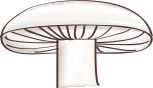
Pileus 4–8 cm in diameter, silvery-grey, covered with fine concolorous granulations visible under a hand lens. Slightly viscid, subdry except in rainy weather, rather convex in shape.
Lamellae very white, rather distant, clearly decurrent on the stipe, with some lamellulae interspersed.
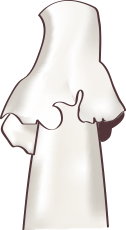
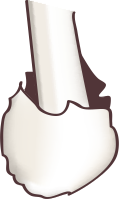
Stipe central and cylindrical, rather whitish, slightly viscid, bearing small farinose granulations in the upper portion. Elongated, reaching up to 10 cm in height.
Flesh white and thick, with a strong and characteristic odor of bitter almonds.
Habitat:
We have only found it under conifers, where it typically fruits in clusters. It is quite abundant during autumn months, especially under Pinus sylvestris. It is a common species.
Observations:
It is edible, though not of high quality, quite different from Hygrophorus latitabundus, a choice edible that appears at the same time and in similar locations. The intense odor of bitter almonds makes it unmistakable; however, due to its appearance it may resemble other Hygrophorus species such as persoonii, distinguished by its habitat under deciduous trees, olivaceoalbus, which is more viscid and has a darker pileus center, and pustulatus, with a stipe dotted black. All of these are harmless or even edible of better quality than agathosmus itself, so confusion poses no danger.
Microscopy of Hygrophorus agathosmus