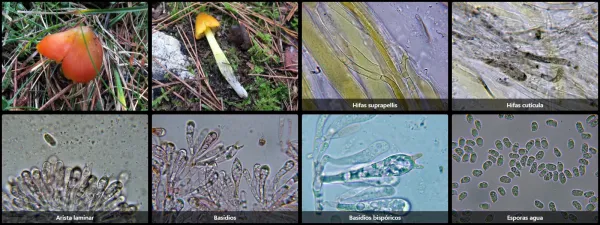

Hygrocybe conica
Taxonomy
Main synonym
Common names
Higróforo cónico, ezko gorri-koniko, pixaconill.
Geographic references:
Interactive map with data from GBIF.
Morphological Features:
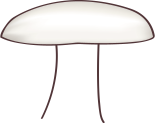
Pileus with a diameter that can reach around 5 cm in mature specimens, often slightly less, exhibiting the typical conical shape indicated by its name. It should be noted that when young it is much more conical and pointed, broadening with age but never becoming flattened. Throughout all stages of development, it retains a very prominent, sharply pointed umbo at the center. The surface is fibrillose and highly variable in color, typically reddish, but also yellowish or orange, slightly viscid when wet and almost always glossy. The entire surface tends to darken with age and upon handling.
Lamellae adnate or more frequently subfree, spaced and broad as is typical for most Hygrocybe species, pale in color, nearly white to yellowish, with a tendency to darken over time starting from the margin.
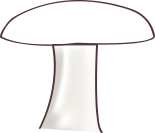
Stipe generally cylindrical and elongated, fibrillose, smooth or longitudinally grooved, sometimes with a prominent central sulcus. It is hollow and non-viscid, ranging in color from reddish to yellowish or orange, occasionally with a greenish tinge, showing a marked tendency to darken.
Flesh rather thin and fragile, yellowish in color with variable intensity, lacking any perceptible odor, and sweet and very mild in taste.
Habitat:
A heliophilous species that fruits equally in meadows and grasslands, as well as in herbaceous clearings of various forest types; it is also found in more ruderal areas. It is a fairly common species that often grows in groups, though sometimes solitary, primarily during autumn, although its occurrence in other seasons cannot be ruled out.
Observations:
This fungus exhibits such extreme color variability that for many years it resulted in the description of several distinct taxa, which we consider to be conspecific. Hygrocybe nigrescens=Hygrocybe pseudoconica was formerly separated on the basis of its tetraspored basidia; however, it has been shown that a single specimen under certain conditions may produce both bispored and tetraspored basidia. Hygrocybe conicoides, typical of coastal dunes and characterized by more elongated spores, is maintained as an independent taxon.