

Hygrocybe coccinea
Taxonomy
Main synonym
Common names
Ezko gorri txiki.
Geographic references:
Interactive map with data from GBIF.


Morphological Features:
Pileus rather small, rarely exceeding 5 cm in diameter, typically measuring 2 to 4 cm; initially spherical in the early stages of development, later expanding to an obtusely convex shape without becoming fully plane. It exhibits a striking, vivid red color that readily catches the eye, although it fades to yellowish or pinkish tones upon drying. The surface is viscid when wet from rain, otherwise glabrous, yet still glossy and smooth. Margin striate due to translucency resulting from its hygrophanous nature.
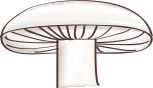
Lamellae fairly distant, adnate to slightly sinuate, striking in color though not as intense as the pileus, displaying more orange to even yellowish hues against a red background. Lamellulae are present towards the margin.
Stipe cylindrical and central, red in color similar to the pileus, though fading from the base towards orange or yellow tones. Usually longer than the diameter of the pileus.
Flesh somewhat insubstantial, scant and fragile, orange in color, with no distinctive odor or taste.
Habitat:
Fruiting occurs during autumn in lowland pastures and grasslands, as well as in herbaceous forest clearings, always growing among the grass. It is frequently encountered in our local region, though rare in other parts of the area.
Observations:
Due to its scant flesh, it is not considered suitable for collection, although it is an innocuous mushroom that does not taste unpleasant. It may be confused with several Hygrocybes among which we highlight Hygrocybe punicea, which is larger and more fleshy; Hygrocybe intermedia, with a fibrillose rather than smooth pileus, as is also the case with Hygrocybe turunda. There are smaller species of similarly reddish coloration such as Hygrocybe marchii or Hygrocybe miniata.