

Hygrocybe chlorophana
Taxonomy
Main synonym
Common names
Hygróforo amarillo, ezko hori.
Geographic references:
Interactive map with data from GBIF.




Morphological Features:
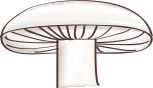
Pileus rather small, occasionally reaching up to 5 cm in diameter but no more, bell-shaped in the early stages of development, later becoming convex, and finally plano-convex, retaining an obtuse umbo at the center. It is bright yellow, conspicuous, especially when young, fading to paler tones upon drying or aging. Its surface is distinctly viscid, a trait that becomes more pronounced on rainy days, and the margin is sometimes slightly striate, though not always, and very thin.
Lamellae adnate or free from the stipe, widely spaced, paler yellow than the pileus, less conspicuous, with a much lighter, almost white edge.
Stipe cylindrical and elongated, bright yellow similar to the pileus and equally viscid, slightly fading towards the base.
Flesh scant and soft, yellow in color; odor barely perceptible; taste very mild and sweet.
Habitat:
A species that sometimes appears in large groups on grassland turf. Fruiting occurs during autumn, particularly late autumn, being one of the most frequent and abundant waxcaps.
Observations:
We classify it as having no culinary value because, despite being a non-toxic species, its scant flesh and mild flavor make it not worth consuming. There are several species within its genus with which it can be confused, many of them yellow-colored, such as Hygrocybe citrina, Hygrocybe constans, Hygrocybe quieta, etc., and others with orange tones like Hygrocybe persistens, which can be confused with var. aurantiaca of the described species. A fairly homogeneous group and therefore difficult to identify.