
Hydnocystis bombycina
Taxonomy
Main synonym
Common names
Not available
Geographic references:
Interactive map with data from GBIF.





Morphological Features:
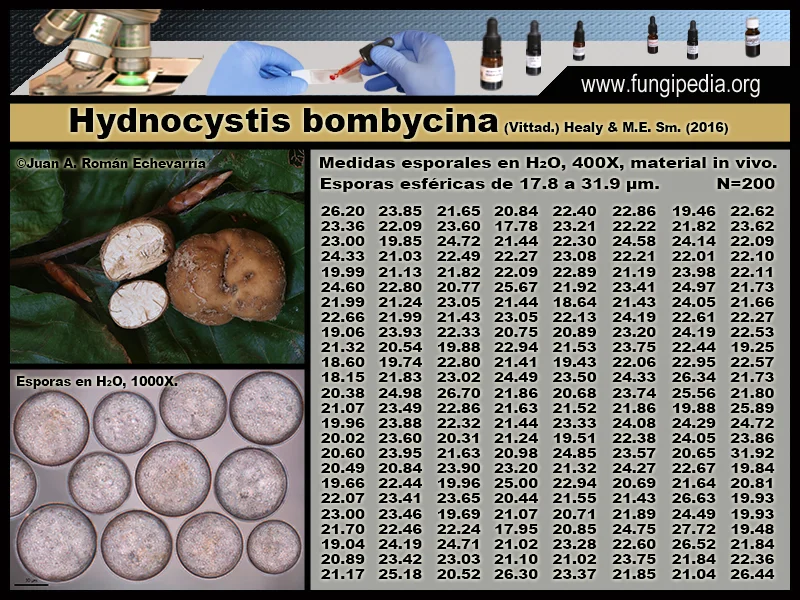
Fruiting body with the typical tuberculate appearance of hypogeous fungi, but quite irregular, often presenting a basal cavity; it may also exhibit irregular lateral fissures, and can even be simply subglobose, ultimately highly variable in shape. Tomentose appearance in young specimens that later disappears, with a certainly small size, ranging from 0.5 to 2.5 cm in diameter across all collected specimens. Color also varies depending on the maturity stage of the specimen, from cream to reddish-ochre or reddish-brown in older individuals.
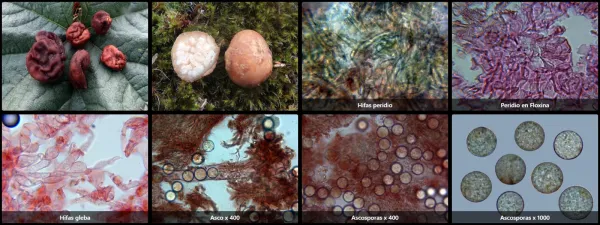
Peridium clearly tomentose in its early stage due to the conspicuous presence of hairs that tend to disappear over time, later becoming smooth, indehiscent, rather thin (less than 0.5 mm), pseudoparenchymatous, exhibiting the color variability described in the previous section.
Gleba whitish or cream-colored, labyrinthine and solid, with virtually no cavities or hollows; veins are concolorous or straw-colored. It constitutes the fertile portion of the fruiting body, producing hyaline and fragile asci and smooth spores (see microscopic features).
Flesh compact and whitish, with a marked onion odor upon collection that becomes highly unpleasant over time, resembling rotting cabbage or decaying organic matter. Its taste is slightly pungent and unpalatable.
Habitat:
This study is based on several collections of the species made across different provinces: three in Álava, one in Navarre, and another in Burgos. In all cases, they share a common denominator: having been collected under beech trees (Fagus sylvatica), although references exist for other trees, generally deciduous. It is a hypogeous species, which makes its location difficult, perhaps leading to it being considered rare in the Iberian Peninsula; however, we have observed that it appears with relative frequency within our study area. We have no evidence of a specific fruiting season, as records exist throughout the year; in our case, collections were made in September and October.
Observations:
A hypogeous fungal species characterized by its small size, its tomentose peridium provided with hairs, its smooth and spherical spores, and its onion odor in young specimens that turns to rotting cabbage later. Due to all these characteristics, it is a relatively easy fungus to recognize; it is the species formerly included in Stephensia that is most frequently encountered in Europe. Hydnocystis colomboi resembles it, especially microscopically, but is an epigeous species that grows on wood and does not have a foul odor. Barssia peyronelii is another species with which it could be confused, although it is well distinguished under the microscope by possessing elliptical rather than round spores.
Microscopy of Hydnocystis bombycina