
Hydnellum ferrugineum
Taxonomy
Main synonym
Common names
Hidno herrumbroso.
Geographic references:
Interactive map with data from GBIF.

Morphological Features:
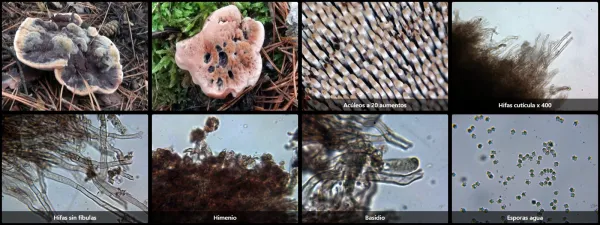
Pileus which in maturity ranges from 5 to 10 cm in diameter, highly irregular in shape, sometimes appearing as a single cap and at other times coalescent, as if several caps were superimposed. Throughout its development, it changes from convex to plane, and finally becomes depressed in the center. Its surface, when young, is whitish and exudes small reddish droplets, but in mature specimens it is clearly rust-brown, darker in the center and somewhat lighter toward the margin. To the touch, it is somewhat hispid, though not always, and the margin is irregularly undulate.
Hymenium composed of a series of spines, similar to those of Hydnum, these may exceed 5 mm in length, and are light-colored when young, acquiring brownish or dull tones with age. They are typically decurrent on the stipe.
Stipe proportionate to the pileus or short, of the same color as the latter, thick and solid.
Flesh very hard and coriaceous, rust-brown in color, barely elastic, with a mild odor, and as for taste, it is practically unchewable.
Habitat:
This is a species typical of pine forests, although we do not rule out its occurrence under other conifers. Many years ago it was a more frequently encountered species, but we believe it is currently in decline. It is fundamentally autumnal.
Observations:
Its hymenium, provided with typical spines, reminds us of Hydnum repandum, but merely observing the coriaceous consistency of its flesh is sufficient to rule out any resemblance to it. The species Hydnellum peckii is very similar, also exuding red droplets when young; it is difficult to differentiate, except by habitat, when young. It is more readily distinguished from Hydnellum aurantiacum, due to the orange flesh possessed by the latter.