
Hydnangium carneum
Taxonomy
Main synonym
Common names
Falsa trufa de color rosado
Geographic references:
Interactive map with data from GBIF.



Morphological Features:
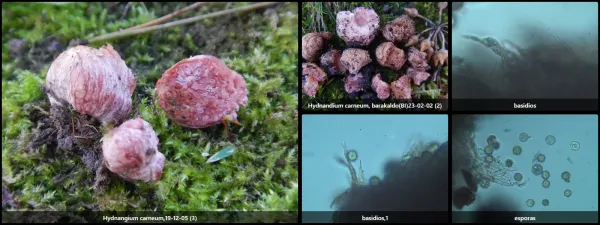
Basidiocarp certainly small in size; the diameter of mature specimens typically ranges from 0.5 to 3 cm. It exhibits the tuberculate shape typical of hypogeous species, but in this case it is quite irregular, ranging from globose to subglobose, and even oblong, and may also display various protuberances or fissures. It has a dry appearance and a color ranging from whitish-pink to distinctly pink. In young specimens, a sort of peduncle or pseudostipe is often present, which is actually nothing more than the convergence of various mycelial cords; this feature is usually absent in mature specimens.
Peridium quite thin, with a generally slightly felted or fibrillose and dry appearance. Its color is whitish with a pinkish tinge in early developmental stages, later becoming distinctly pinkish-carnose, with some darker spots in handled areas. It is quite common for the peridium to partially disappear, revealing the gleba.
Gleba compact and fleshy, composed of a series of folds with a somewhat labyrinthine yet irregular appearance, generally more tightly packed near the base and more open towards the apex. It has a color similar to the peridium, pinkish-carnose, slightly whiter when immature, and like the latter, it may exhibit some spots due to oxidation. The columella is prominent and central in some specimens, while in others it is barely discernible.
Flesh absent beyond the gleba itself; odor is quite mild and faint, and taste is slightly sweetish.
Habitat:
This is a species that can be described as semi-hypogeous, as it initially develops underground at shallow depth but usually protrudes slightly to the surface upon maturing. It is exclusive to eucalypt stands (Eucalyptus ssp), where it is considered a frequent species, although its small size and semi-hypogeous nature make it somewhat difficult to locate. It typically fruits during winter and spring, generally in groups, rarely solitary. The specimens studied here were located by Javier Fernández Vicente at the Barakaldo Botanical Garden, fruiting under Eucalyptus cinerea.
Observations:
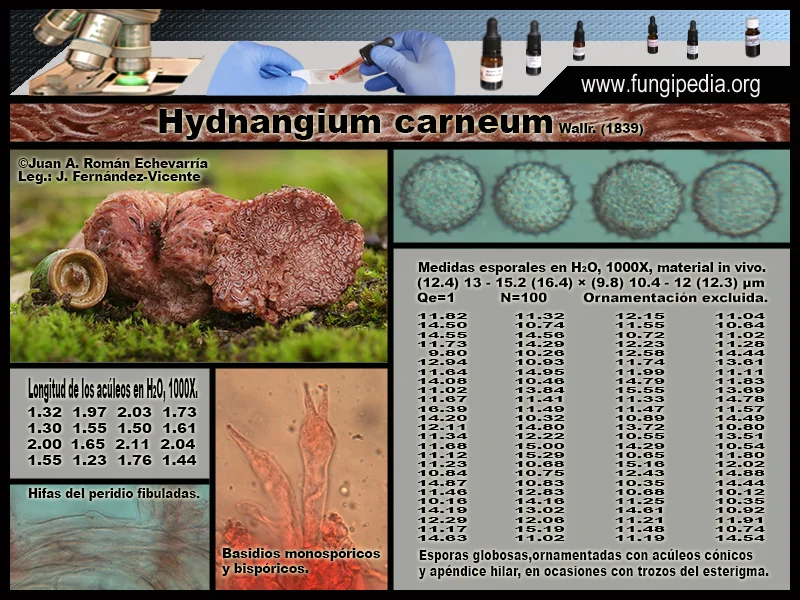
This species is characterized by its exclusive habitat under Eucalyptus ssp, its small size, semi-hypogeous growth habit, and the prominent pinkish-carnose color of all its parts, which gives rise to its specific epithet. Microscopically, it is characterized by globose spores adorned with evident pointed or conical aculei, and by possessing both bisporic and monosporic basidia; these features can be observed in our "Microscopic Features" section. Species of this genus are of Australian origin and have been introduced to Europe through eucalypt reforestation. They are phylogenetically closely related to the genus Laccaria, to the extent that there is growing scientific consensus to regard them as gastroid forms of that genus, and to associate this particular species with Laccaria fraterna, which is highly abundant in our local eucalypt stands.
Microscopy of Hydnangium carneum