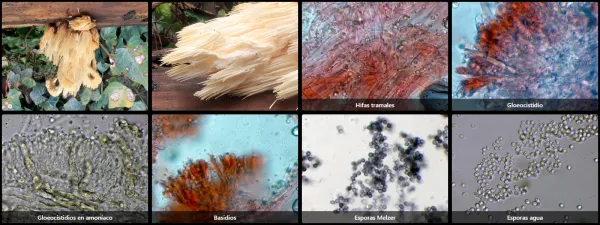
Hericium erinaceus
Taxonomy
Main synonym
Common names
Melena de león, barba de cabra, ahuntz-bizar, bolet carner.
Geographic references:
Interactive map with data from GBIF.





Morphological Features:
Fruiting body formed by a tongue-shaped or rectangular base attached or seated on the wood that serves as its substrate, white in color. From it arise numerous spines of considerable length; in some cases they can reach up to 5 cm long, though it is most common to find them measuring 2 to 3 cm. These spines are notably fragile and flexible, and may detach from the base upon handling of the specimen. When young, the spines are white, but as the fruiting body develops they turn cream-colored, and at the end of the process they adopt ochraceous tones due to aging.
Hymenium formed by a series of spines arranged vertically.
Stipe absent; it is a sessile species.
Flesh thick and white, with a somewhat elastic consistency, bearing a mild fungal odor and a sweet, equally mild taste.
Habitat:
A species that develops on the trunks of living broadleaf trees. It appears mainly during late autumn, and sometimes even in early winter. It is not an abundant species, but neither is it rare.
Observations:
It is said that when young it constitutes a good edible, although it later becomes somewhat tough. It has medicinal applications as a protector of the upper gastrointestinal tract. Regarding possible confusions, we will mention Hericium coralloides, which has short spines supported on branched structures, and Hericium cirrhatum, which possesses well-differentiated caps from which the spines arise.