Hericium coralloides
Taxonomy
Main synonym
Common names
Hongo en forma de coral.
Geographic references:
Interactive map with data from GBIF.





Morphological Features:
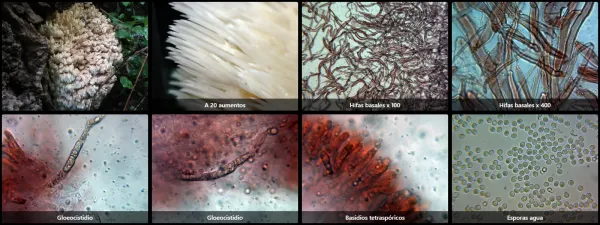
Basidiocarp fruits initially as a somewhat deformed mass, from which a series of coral-like branches grow, arranged irregularly. Hanging from these branches are spine-like structures distributed arbitrarily in both arrangement and number, giving the basidiocarp an attractive appearance at maturity. The color is white, though it turns somewhat creamy with age, and it can reach up to 30 cm in width by 10 cm in depth.
Hymenium composed of irregular spines or teeth arranged vertically.
Stipe whitish-yellow, very short, barely perceptible. Stout and branched.
Flesh whitish, with a radish-like odor and not overly pleasant taste when raw, somewhat tough, especially in older specimens.
Habitat:
Fruits in both summer and autumn on decaying logs of deciduous trees, rarely on living trees, and even more rarely on conifers. Very uncommon, difficult to locate.
Observations:
Although young specimens can be consumed, this fungus lacks culinary value. It may be confused with Hericium erinaceus, which possesses much longer and clustered spines that are unbranched. It may also be confused with Hericium cirrhatum, which is more yellowish and consists of several caps from which the spines hang. The species Hericium alpestre is described on living firs and is very similar to the species described here.