
Hemitrichia serpula
Taxonomy
Main synonym
Common names
Not available
Geographic references:
Interactive map with data from GBIF.
Morphological Features:
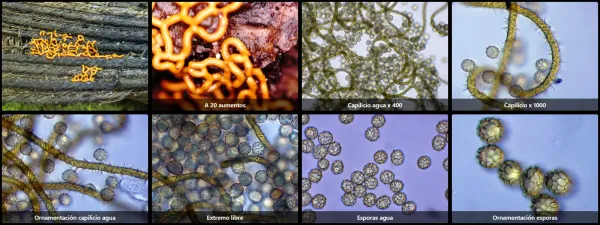
Plasmodiocarp arising from an orange-colored plasmodium, initially difficult to distinguish from it as it utilizes the branching network of the plasmodium itself to expand. Lacking a stipe, it adopts different colors throughout its development, ranging from the initial orange to a matte yellow, eventually becoming somewhat ochraceous in its final phase. It spreads across the substrate for no more than 3 cm, always maintaining that branched form. The peridium is membranous and longitudinally dehiscent, composed of a fragile structure. Upon dehiscence, the capillitium is revealed, consisting of a series of pale yellow spinose fibers arranged in a spiral pattern. The spores are located among these capillitial fibers.
Spores yellowish in color and subglobose in shape, measuring 11 to 14 μm, with a well-defined external reticulum.
Stipe absent; it is a sessile species.
Habitat:
It is a species that is difficult to locate, fruiting at any time of the year provided conditions are optimal. The photographs presented were taken in February 2010 on a decaying trunk of Fagus sylvatica in the province of Álava.
Observations:
A myxomycete belonging to the Trichiales, characterized primarily by the absence of a stipe, its branched structure resembling that of the plasmodium itself, and its color variability throughout development. Proper microscopy is essential for the accurate determination of these species. It is precisely this structural feature that distinguishes it from other species within its genus, which typically possess a stipe.