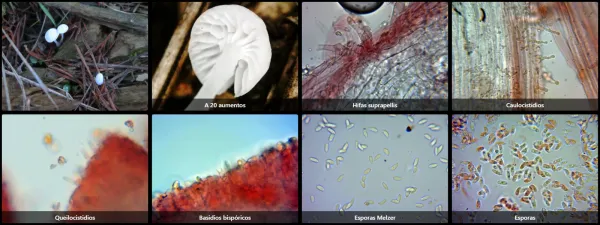

Hemimycena lactea
Taxonomy
Main synonym
Common names
Not available
Geographic references:
Interactive map with data from GBIF.


Morphological Features:
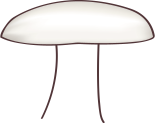
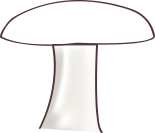
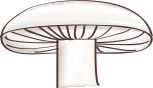
Pileus with a diameter ranging from a few millimeters to 2 cm; initially bell-shaped in early stages, then convex, eventually flattening out, sometimes bearing an obtuse, not very prominent umbo at the center. The cuticle is smooth, milky white and matte in young specimens, later turning cream-white, with older specimens occasionally showing yellowish discolorations in the central area. Margin striate by transparency and irregularly undulate.
Lamellae adnate to subdecurrent, pure white in color, not too crowded, and interspersed with lamellulae.
Stipe cylindrical and often curved, watery white in color and nearly translucent. Elongated, smooth or finely pruinose, with white rhizomorphs at the base where it joins the mycelium. It has a somewhat elastic or flexible consistency.
Flesh scanty, whitish in color, with a faint but rather unpleasant odor and a similar taste.
Habitat:
This is a species characteristic of pine forests, where it grows in clusters directly on pine needles. It is a frequent species that fruits primarily during autumn, although it has also been found in winter.
Observations:
The genus Hemimycena comprises small-sized, white species; it differs from the genus Mycena macroscopically in that Mycena species have a fragile stipe that breaks off merely upon handling, whereas Hemimycena species possess a flexible one. Microscopically, Mycena spores are amyloid, while those of Hemimycena are not. Hemimycena cucullata is very similar, but it grows on plant debris or dead leaves and exhibits a hood-like shape. Another similar species is Hemimycena candida, which has an exclusive habitat on withered comfrey plants.