
Helvella macropus
Taxonomy
Main synonym
Common names
Kaliza hankaluze.
Geographic references:
Interactive map with data from GBIF.



Morphological Features:
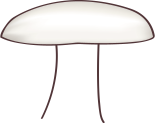
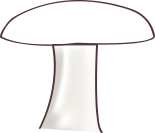
Pileus cup-shaped in most cases, although sometimes, especially with age, it tends to flatten. It usually measures 2 to 3 cm in diameter, and its external surface is covered with very short hairs only visible under a magnifying glass; to the naked eye it appears farinose. Its color is gray, typically very pale, almost whitish.
Hymenium formed by the inner surface of the pileus, smooth and similarly gray in color, but typically darker than the external surface.
Stipe cylindrical and slender, slightly thickened at the base, smooth or slightly grooved, reaching up to about 5 cm in height. Like the external surface of the pileus, it bears fine hairs and is concolorous with it.
Flesh scant, inconspicuous, and elastic in consistency. Neither odor nor taste is distinctive.
Habitat:
It is a scarce but not rare species, occurring equally in both coniferous and deciduous forests, from late spring through autumn.
Observations:
This species is characterized by its grayish, cup-shaped receptacle and a concolorous stipe that appears as an extension of it. Macroscopically, it closely resembles Helvella dissingii, whose spores lack the three droplets (lipid guttules) present in the described species. This has led to the establishment of the subgenus Macroscyphus for this species.