Helvella leucopus
Taxonomy
Main synonym
Common names
Bonete, orejón, capilote.
Geographic references:
Interactive map with data from GBIF.





Morphological Features:
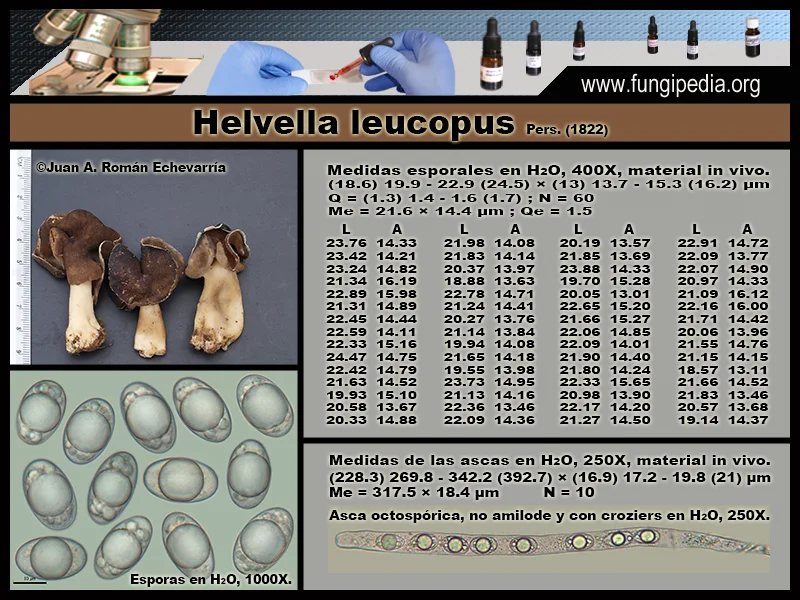
Pileus 2 to 4 cm high, slightly wider than tall, bonnet- or mitre-shaped. It is composed of several lobes, generally 3 or 4, black or dark brown almost black, with somewhat irregularly involute margins. The infertile surface is less conspicuous and more greyish in color. The margin is usually attached to the stipe, but not entirely, resulting in some gaps or cavities between them.
Hymenium located on the most conspicuous surface of the pileus, smooth and blackish.
Stipe 2 to 5 cm tall, smooth, lacking longitudinal ridges, possibly bearing only faint lines, whitish and somewhat thickened at the base, hollow.
Flesh elastic and fragile in the pileus, leathery in the stipe, rather scanty and whitish, without notable odor or taste.
Habitat:
An eminently spring fruiting body, appearing along riverbanks and in sandy areas. It is common in certain regions of the Iberian Peninsula, such as La Rioja and Castile and León, particularly in poplar stands, though not exclusively.
Observations:
Despite its scanty and somewhat leathery flesh in the stipe, it is the Helvella species with the greatest culinary tradition; however, we must not forget that it is toxic when raw, like all its congeners, and therefore must be cooked beforehand. It resembles Helvella lacunosa, which has a stipe with very pronounced ridges, and especially Helvella atra, which has a grey to blackish stipe.
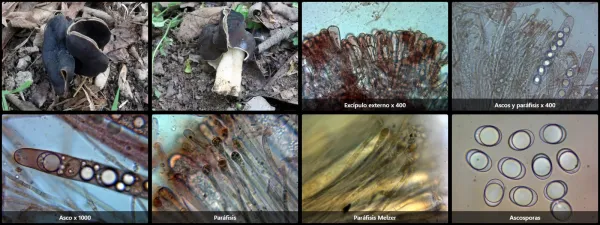
Microscopy of Helvella leucopus