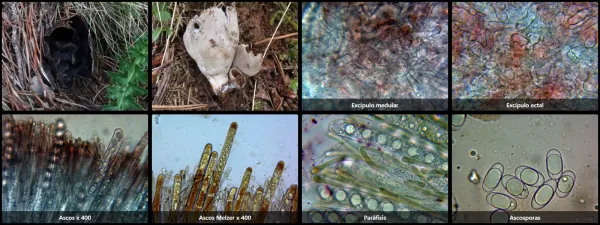

Dissingia leucomelaena
Taxonomy
Main synonym
Common names
Pucheruelo, cassoleta, kaliza zuri-beltz.
Geographic references:
Interactive map with data from GBIF.
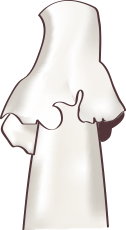
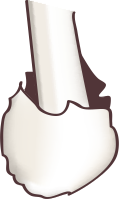
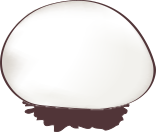
Morphological Features:
Pileus small, reaching 2 to 3 cm in height and approximately 3 to 4 cm in diameter, cup-shaped for much of its development, gradually opening until flattening at maturity. The external surface is smooth and whitish or cream-colored in young specimens, though it darkens over time to dark gray tones starting from the margin. Margin smooth and straight when young, later becoming irregularly toothed.
Hymenium located on the inner surface of the fruit body, gray in color darkening to brownish almost blackish tones in the final stage of development.
Stipe very short, whitish in color, longitudinally grooved by a few folds that may form cavities, and barely extending onto the pileus.
Flesh thin and white, brittle like most Helvella species. Odor weak and taste sweet and mild.
Habitat:
A species that fruits in late winter, but primarily during spring, in more or less numerous groups. Its preferred habitat is pine forests, though it is also found under other conifers. It is an uncommon mushroom.
Observations:
It is valued as edible in certain regions of our geography, yet it is toxic when raw, like all its congeners. There is a belief in those areas that the false cup fungus (Helvella acetabulum) is highly toxic while this species is not; this is entirely false, as the toxicity of both species is identical. More toxic and dangerous is Sarcosphaera coronaria, which also appears in spring in pine forests, larger in size, with a lilac hymenium and lacking a stipe.