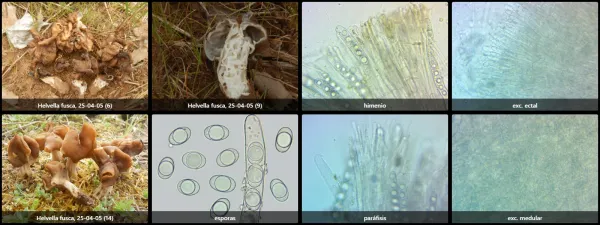

Helvella fusca
Taxonomy
Main synonym
Common names
Not available
Geographic references:
Interactive map with data from GBIF.



Morphological Features:
Pileus irregularly lobed or folded in shape; it typically adopts a saddle-like form with two lobes, but this is not always the case and it sometimes presents three lobes and a more indefinite shape. It usually measures 2 to 3 cm in height by 3 to 4 cm in length, with a brown color on the external surface, which is rugose. The internal surface is whitish or creamy, somewhat more ochraceous in older specimens, and is provided with characteristic raised ridges that sometimes form a broad reticulate pattern.
Hymenium immersed in the upper region of the ascocarp, brown and rugose; when the specimen is sporulating, these white spores in mass are visible to the naked eye as a powdery coating that detaches upon shaking the specimen.
Stipe hollow, 3 to 5 cm long, whitish or creamy in color, somewhat more ochraceous when old. It presents longitudinal ridges, rarely alveolate but anastomosing. More or less cylindrical or broadened at the base.
Flesh thin and brittle, concolorous, without a perceptible odor, and with a mild, sweet taste.
Habitat:
This is a species fundamentally associated with riparian trees, with a preference for poplars and sandy areas. It usually appears in not very numerous groups, primarily during spring, although it is not exclusively spring-fruiting and, depending on the region, may also appear in winter and occasionally in autumn. Nevertheless, it is an infrequent species and less abundant than other congeners.
Observations:
Like all species of its genus, it is toxic when raw and must be cooked prior to consumption; due to its scarcity, it is generally not collected for this purpose. Due to its coloration, it may be confused with Paxina queletii, which however has a hooded pileus and fewer ridges; Helvella leucopus has a smooth stipe, and other Helvella species whose stipes possess ridges are grayish or black in color. The clearest distinguishing characteristic is the ridging of its internal surface.