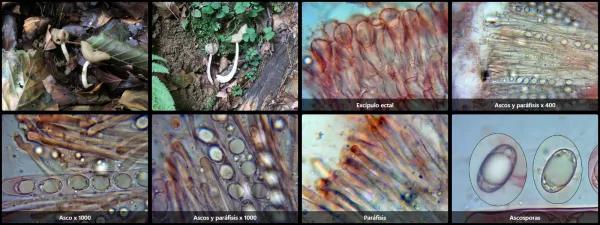

Helvella elastica
Taxonomy
Main synonym
Common names
Mitra malgu, moraga elástica.
Geographic references:
Interactive map with data from GBIF.



Morphological Features:
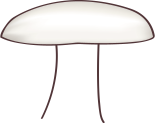
Pileus small in size, barely 2 to 3 cm long, which may be shaped like a gnome's hat or a saddle, irregularly lobed, but with no more than 2 or 3 lobes. The margin is usually incurved. Its color is highly variable and thus not a distinguishing feature, ranging from whitish-grey to brownish-ochre.
Hymenium completely smooth and reflexed upwards, formed on one of the surfaces of the pileus, cream to pale ochre in color.
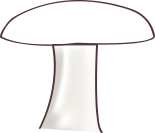
Stipe hollow, white or cream-colored, relatively long in proportion to the pileus size. Its main characteristic is the complete absence of any ribs or grooves; it is entirely smooth and slightly pubescent.
Flesh elastic in consistency, as the species name suggests, with no distinctive odor or taste.
Habitat:
Fruits in summer and autumn, without particular requirements regarding forest type or soil. Despite being fairly widespread, it is not a very frequent species.
Observations:
It is of mediocre edibility and should only be consumed after cooking; it is toxic when raw. It is easily distinguished from other Helvella species such as Helvella lacunosa by its smooth, non-grooved stipe. Another species in the smooth-stiped group is the well-known bonnet fungus, or Helvella leucopus, which however is much darker than the species described here.