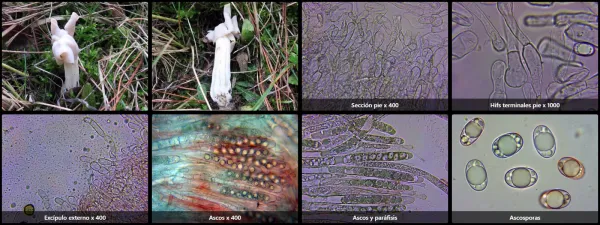
Helvella crispa
Taxonomy
Main synonym
Common names
Oreja de gato, mitra zuri, barretet.
Geographic references:
Interactive map with data from GBIF.





Morphological Features:
Pileus crisped, bonnet- or saddle-shaped, composed of a series of irregularly folded lobes, reaching up to 5 cm wide at maturity, and whitish to creamy white in color.
Hymenium formed on one surface of the pileus, which is so deeply folded that it is difficult to discern whether it represents the inner or outer face. It is completely smooth, lacking any folds or lamellae, and more ochre in color than the opposite surface.
Stipe white, slightly pruinose, usually quite long and reaching up to 10 cm, longitudinally grooved by a series of ridges running its entire length, imparting a highly characteristic ribbed appearance.
Flesh quite fragile, somewhat tougher in the stipe, leathery. When young it lacks any distinctive odor, but upon maturing it develops a penetrating, though not excessively unpleasant, smell; nothing remarkable regarding taste.
Habitat:
Found equally in coniferous or deciduous forests, typically in ruderal areas rather than deep within the woodland. Fruiting occurs in spring and also during autumn. A frequent species.
Observations:
An edible mushroom after cooking, as it is toxic when raw, like most of its congeners. The whitish color of the pileus distinguishes it from other Helvella species such as Helvella fusca or Helvella lacunosa, which exhibit much darker tones, although they also feature a ribbed stipe.