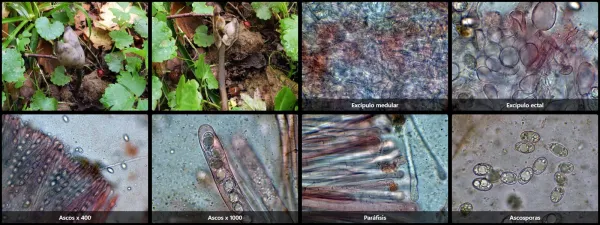

Helvella atra
Taxonomy
Main synonym
Common names
Not available
Geographic references:
Interactive map with data from GBIF.
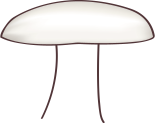
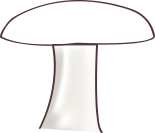


Morphological Features:
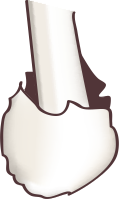
Pileus with a typical saddle shape in young specimens, later tending to become irregularly lobed. Its approximate size is 2 to 4 cm in height by the same in length, and its margin is thin and undulate, typically attached to the stipe at one or more points. The infertile inner surface is fundamentally gray in color, darkening over time to dark gray, almost black, and is additionally pruinose or finely furfuraceous.
Hymenium located on the most exposed or outer surface, completely smooth, dark gray to practically black in color.
Stipe elongated and cylindrical, gray in color, though like the pileus it tends to darken. It usually lacks grooves or fissures, although it may occasionally exhibit a small central groove. It is pruinose and has a glossy surface when wet, but is not viscid. All collected specimens, regardless of their developmental stage, exhibited an ochraceous base.
Flesh scant and fragile, gray in color, with a pleasant fungal odor and an insignificant taste.
Habitat:
We have not confirmed a specific habitat for this species; the photographed specimens were found on the bank of a stream, with the nearest trees being oaks, alders, and hazels. We have located it in autumn, although we are aware of collections dating back to June. It is a very infrequent species.
Observations:
It is a rare species worthy of protection; we classify it as without culinary value, due to the fact that, in addition to being toxic when raw, it has scant flesh. There are some congeners whose separation from this taxon is controversial; we will cite Helvella pezizoides, which is similar to this one, but whose stipe and infertile portion of the pileus are villous rather than furfuraceous, having a more brownish-gray to blackish color. By color it resembles Helvella lacunosa, but the stipe is deeply grooved, by which it is perfectly distinguished.