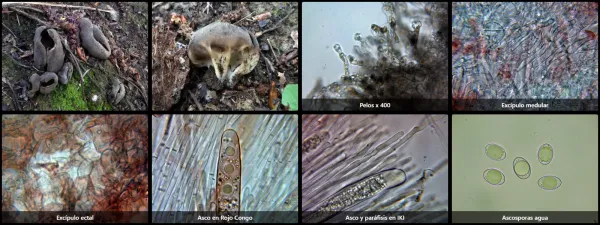

Helvella acetabulum
Taxonomy
Main synonym
Common names
Calabacitos, calabacicos, kaliza arrunt, bocabadat bru.
Geographic references:
Interactive map with data from GBIF.




Morphological Features:
Fruiting body cup- or goblet-shaped, occasionally discoid when the stipe is embedded in the substrate. Its size is remarkable for its genus, potentially exceeding 5 cm in diameter. The external surface is grayish-brown to light brown, fading towards the stipe, and is typically finely pubescent.
Hymenium completely covering the internal surface of the fruiting body, entirely smooth, and brown in color.
Stipe generally short, white to cream-colored, longitudinally furrowed by deep ribs that extend into the receptacle, occupying its lower portion, and occasionally forking.
Flesh scant and rather elastic, with an earthy odor and a mild taste.
Habitat:
This fungus appears exclusively throughout spring; it is very frequent and cosmopolitan. We have found it under diverse trees such as pine, poplar, or also lime.
Observations:
We consider it not worth consuming, although it can be eaten if cooked beforehand, as it is toxic when raw. We believe it is easily identifiable by its stipe bearing ribs that extend into the receptacle; it can only be confused with Helvella costifera, which is somewhat more flattened and less brown, an autumnal species.