
Hebeloma sinapizans
Taxonomy
Main synonym
Common names
Hebeloma con olor a rábano, arbiki falkadun.
Geographic references:
Interactive map with data from GBIF.


Morphological Features:
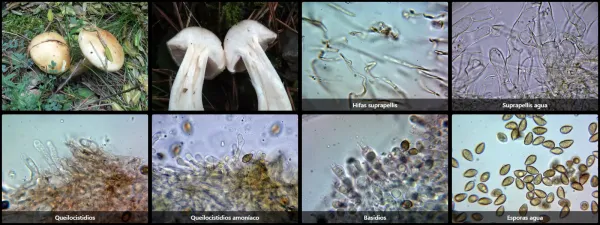
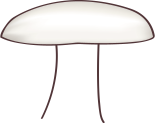
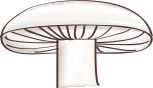
Pileus of substantial size, representing one of the largest species in its genus, frequently exceeding 10 cm in diameter. Its shape evolves from hemispherical to convex and subsequently plano-convex; a raised center or umbo is quite common, and it may occasionally be undulate with various ridges, this being a variable character. The cuticle is lubricous in wet weather and otherwise satiny, ranging in color from pale suede-ochre to reddish-brown. The margin is incurved in young specimens, later becoming somewhat undulate.
Lamellae adnate to subfree with lamellulae, relatively crowded and of irregular width. Initially pale, they later turn milk-coffee colored and finally brown. The gill edge is sometimes slightly paler than the rest and exhibits no exudation.
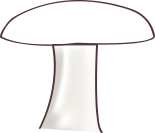
Stipe cylindrical or slightly clavate, proportional in size to the pileus, cream-colored and covered with slight flocculence that stains with the spore color. It soon becomes hollow or cavernous; a longitudinal section will consistently reveal a characteristic triangular tongue-like flap at the point of attachment to the pileus.
Flesh thick and fibrous, whitish in color. It possesses a strong radish-like odor and an unpleasant taste.
Habitat:
This species occurs equally in coniferous or broadleaf forests, with autumn being its preferred fruiting season, though it is also observed in late summer and may persist into early winter. It is a frequent and locally abundant species that typically fruits in small groups.
Observations:
This is a Hebeloma capable of causing gastrointestinal disturbances, although this aspect remains poorly studied. Its considerable size and the characteristic triangular tongue-like flap present in the upper region of the stipe aid in the identification of this species, requiring a longitudinal section for observation. Hebeloma crustuliniforme is very similar, but lacks this flap, is paler, and often exudes milky droplets. It is not entirely clear whether the taxon presented here represents a single species or several lumped together; Hebeloma laterinum has been separated as an independent taxon for reddish specimens with a sweet odor.