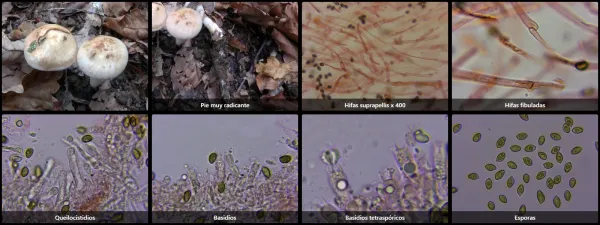
Hebeloma radicosum
Taxonomy
Main synonym
Common names
Hebeloma radicante, arbiki errodun.
Geographic references:
Interactive map with data from GBIF.




Morphological Features:
Pileus with a fleshy appearance and a diameter that can be quite substantial, typically ranging from 5 to 10 cm, though it may exceed this size. Initially hemispherical in shape, it later becomes convex and finally flattens considerably. The cuticle is viscid in wet weather, retaining a certain sheen under other conditions; its color is variable, ranging from cream to ochre, and often exhibits a typical pale leather tone. This surface may be smooth or somewhat scaly, and the margin, sometimes paler, bears remnants of the universal veil in young specimens, which later disappear.
Lamellae adnate to subfree, pale cream-colored in young specimens, rapidly turning brownish, sometimes with a yellowish tinge. They are fairly crowded and irregularly arranged.
Stipe elongated, solid, and fusiform, similar in color to the pileus. It tapers toward the base, terminating in a long root-like extension; indeed, the subterranean portion of the stipe is often as long as or longer than the exposed part. The upper third bears a very conspicuous, persistent membranous ring, beneath which darker floccose markings are present.
Flesh thick and whitish, fibrous in the stipe, with a sweet taste, not bitter at all, and an odor that is not unpleasant but difficult to define, reminiscent of herbs with an undertone of bitter almonds.
Habitat:
This is a species that, although it fruits on the ground, typically does so in close proximity to highly degraded old stumps. It fruits under broadleaf trees; in our region, it is commonly observed beneath beeches. Nevertheless, it is not an abundant mushroom, despite appearing with some regularity. Its preferred fruiting season is autumn.
Observations:
Within a genus that is notoriously difficult to delimit and contains many closely related species, this may be one of the few that presents minimal identification challenges. Its macroscopic features are distinctive: its fleshy appearance, the ringed stipe terminating in a long root-like base, the non-bitter taste, and its peculiar odor all render this species readily identifiable.