
Hebeloma birrus
Taxonomy
Main synonym
Common names
Not available
Geographic references:
Interactive map with data from GBIF.

Morphological Features:
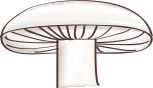
Pileus in developed individuals can reach 5 cm in diameter, usually ranging between 2 and 5 cm; initially hemispherical, then convex, and finally flattened, though slightly raised at the center, with an obtuse umbo in some specimens. Cuticle may become shiny when wet but is not viscid, rather dry, with variable coloration; uniformly ochre in early developmental stages, it tends to fade from the margin over time, retaining ochre at the center with a reddish tinge, and a cream-colored margin, although this is an inconsistent character. Margin fairly regular and slightly undulate.
Lamellae sinuate, brown in color, generally relatively crowded with abundant lamellulae; the lamellar edge is entire and lighter in color.
Stipe elongated, considerably exceeding the pileus in length, cylindrical and rooting at the base, which is occasionally provided with a pseudorrhiza. It may be faintly sulcate and is quite fibrillose; its appearance sometimes recalls species of the genus Hypholoma. Lacks a partial veil.
Flesh not very thick, cream to pale ochre in color, with a somewhat elastic consistency; odor mild, lacking the typical radicin-like smell of the genus, and taste bitter.
Habitat:
This is a species with certainly variable ecology, ranging from burned areas to various types of forests, with a certain predilection for conifers. It typically fruits in groups, rarely isolated, especially during the autumn months. Our collection was made in October under Pinus radiata.
Observations:
According to a study conducted in 2005 by J. Vesterholt, several species have been found to be synonymous with this one, such as Hebeloma calyptrosporum or Hebeloma anthracophilum; this is due to the numerous ecological forms of this Hebeloma and its high morphological variability. Within the genus, this species is characterized by the absence of a partial veil, the equally absent radicin-like odor typical of other congeners, and an appearance that sometimes recalls species of the genus Hypholoma. No species in the genus has culinary interest, and some are toxic; regarding potential confusion, it may resemble other bicolored pileus Hebeloma species such as Hebeloma mesophaeum or Hebeloma cylindrosporum, but they differ microscopically, or also Hypholoma elongatum.
Microscopy of Hebeloma birrus