Gyroporus castaneus
Taxonomy
Main synonym
Common names
Boleto castaño, gaztain onddo, sureny castany.
Geographic references:
Interactive map with data from GBIF.




Morphological Features:
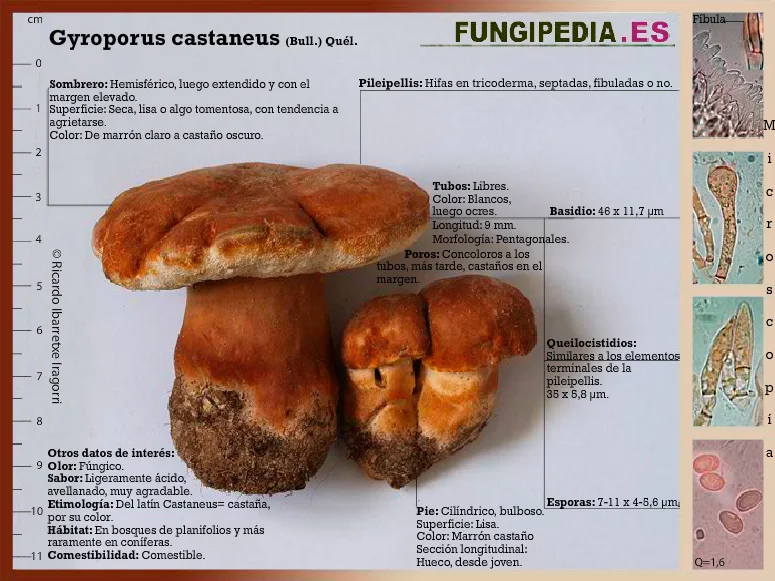
Pileus reaching at most 10 cm in diameter, thus not large; hemispherical when young, becoming convex and finally expanded, with a slight central depression and an upturned margin in age. Its color varies within brown tones, from cinnamon-brown to chestnut. The surface is somewhat tomentose when young, later becoming smooth, and remains dry even during rainy periods, never viscid.
Tubes relatively long in proportion to the size of the fruitbody, white, turning ochraceous only late in age. They remain unchanged upon handling or cutting and are free from the stipe.
Pores concolorous with the tubes, becoming ochraceous-stained in age, especially at the margin; narrow and polygonal. They do not blue upon pressure.
Stipe central and cylindrical, thick, chestnut or light brown in color, closely resembling that of the pileus. It becomes hollow and cavernous from the base at an early stage.
Flesh thick and firm in the pileus, white and unchanging when cut, with a mild, pleasant odor and a pleasant nutty flavor.
Habitat:
This species is generally found under deciduous trees, and more exceptionally under conifers. It is a highly localized species, not easy to find within our local area.
Observations:
It is a good edible with a pleasant flavor, well worth tasting. It is commonly confused with Gyroporus cyanescens, a species of similar culinary value, whose flesh blues markedly and whose pores become yellowish in age.
Microscopy of Gyroporus castaneus