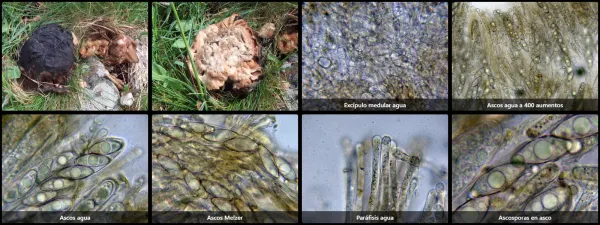
Gyromitra gigas
Taxonomy
Main synonym
Common names
Not available
Geographic references:
Interactive map with data from GBIF.




Morphological Features:
Pileus up to 10 cm wide by 5–8 cm high, striking in appearance, brain-shaped, with irregular wrinkles and prominences. Color light brown to hazelnut, fairly uniform, slightly paler on the inner surface. Attached to the stipe at multiple points.
Hymenium covering the entire external surface of the fruit body, smooth and concolorous.
Stipe rather short, reaching barely 5 cm in height at maximum maturity, sometimes as wide as it is tall. Hollow, smooth, and whitish in color.
Flesh fragile in the pileus, more elastic in the stipe, without a significant odor and mild in taste.
Habitat:
An exclusively spring species, rare under broadleaf trees, and even rarer in coniferous forests.
Observations:
We consider this a toxic species, as it contains gyromitrin, similarly to Gyromitra esculenta. The resemblance between both species is notable, although the one described here typically has a shorter stipe, is hazelnut-colored, and somewhat more robust. Both are spring fruiting, although Gyromitra esculenta usually appears under pines.